
Jai Chakrabarti
Welcome to The Burning Hearth. I’m currently sitting in one of my favorite French cafes in Shorewood, WI. Outside, it is a picture-perfect late summer morning. Inside, my senses are alive. The scent of fresh baguettes, croissants, and coffee fills the air. Jazz music, and friendly conversations between customers, pleasantly disrupts the white noise of ceiling fans. I am enjoying a cup of English Breakfast tea and my surroundings, while I’m writing the introduction to this interview.
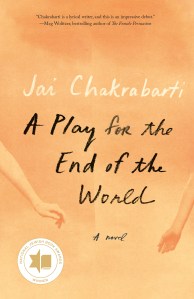
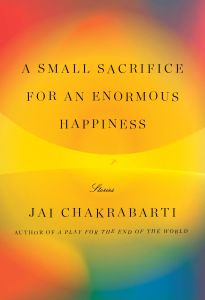
Jai Chakrabarti is the author of the novel A Play for the End of the World and the short story collection A Small Sacrifice for an Enormous Happiness. (Please be sure to read his bio at the end of the interview as it lists the awards and recognitions he has received for both.) It has been a long time since I’ve been as moved by someone’s writing as I’ve been by Jai’s. His characters, the complexities of life that he delves into, his craft; all of these, and more, generate a multitude of questions in me. To that end, I had three different approaches to my questions; and eventually, in part due to circumstances that happened in my life while working on his interview, I settled on the direction of questions included here.
It is my sincere hope, if you are not familiar with Jai and his writing, that this interview inspires you to visit his website, learn more about him, and read both A Play for the End of the World and A Small Sacrifice for an Enormous Happiness. I can promise, you will be changed for the better for having done so.
An Interview with Jai Chakrabarti
BH: Jai, welcome to The Burning Hearth. As I’ve shared with you, I am so honored to be in conversation with you. I was left with much to ponder after reading your novel A Play for the End of the World, and your short story collection A Small Sacrifice for an Enormous Happiness.
I want to begin by discussing A Play for the End of the World and to thank you for introducing me to Janusz Korczak, to the life and death of the children who were under his care at the orphanage in the Warsaw Ghetto, to Rabindranath Tagore and his play The Post Office, and to your character Jaryk and his wounded, hopeful soul.
I read in your interview with David Naimon that you discovered Janusz Korczak and his story while visiting Yad Vashem, the Holocaust Museum in Israel. (Readers can listen to your interview with David here or read it here.) I’m curious, what was it about Korczak that made you want to write this book? After reading about him, I can think of many reasons one would be moved to share his story, but I’m interested in hearing why you were personally inspired to share Korczak’s story.
JC: Hi Constance, it’s such a pleasure to be in conversation with you, and I’m so grateful for your close reading of my work. Janusz Korczak contained multitudes, as a doctor, as an author, as the host of a popular radio show, though my connection to him was primarily drawn from his life as the founder of an orphanage. I remember the moment that I learned how Korczak had decided to stage a Bengali play in the Warsaw Ghetto and feeling my life had been transformed, that what I had just taken in had turned me into a different person. To say it another way, I had a personal connection to the play, but I was moved by the defiance, that Korczak would turn to art in such a moment of despair and hopelessness. This notion of turning to art in times of struggle has remained a cornerstone of my own artistic vision even when everything else argues against it.
BH: A Play for the End of the World is at once a story about the preparation to die and a story about the preparation to live. There is Korczak, literally preparing the children for their march from the orphanage to the train that will take them to Treblinka where they will be murdered; there is Amal, the dying boy in Tagore’s play, The Post Office, who is preparing, or more accurately stated, being prepared, for death; again there is Korczak, setting The Post Office on the children of his orphanage as a way of figuratively and emotionally preparing them for their inevitable fates; and then, there is Jaryk, the main character of your story, living in Korczak’s historically-fictionalized orphanage, who is cast by Korczak as Amal, and who is, ironically, one of only two survivors from the orphanage. It is Jaryk’s journey that moves A Play for the End of the World from a story about death into a story about life.
In the time between writing the paragraph above and sitting down to fashion it into a question, my 94-year-old mother passed away. I originally began this sentence by stating that my mother was terrified of dying. But the truth is she was terrified of living. Emotionally and mentally crippled by her inability to let go of her past, she was never able to face those truths that oftentimes disturb and disquiet us before their revelations can heal and deliver us. My mother did not understand the difference between a spiritual death and actual death, and she feared the former would most definitely facilitate the latter. Therefore, she clung to her past. And not only the past circumstances of her life, but also her past self, as does your character Jaryk.
Jaryk is an unintended survivor of the Warsaw Ghetto, a fate he cannot reconcile. His history leaves Jaryk with deep questions regarding his value as a person to both be alive and to be loved. And as long as his friend Misha, the other survivor, is still alive, Jaryk can more comfortably stay rooted in the past. But then Lucy enters the picture. She, along with the events around the unexpected death of Misha, disturbs and disquiets Jaryk. A cascade of triggering events, along with the discovery of Lucy’s pregnancy, propels Jaryk out of his past and into life where healing and deliverance can occur.
All of what I’ve just written leads me to three things I am interested in having you speak to.
- Korczak refuses to leave the children of his orphanage and save himself. He is offered, several times, the ability to escape the fate of the mass deportations, but he refuses. If I remember correctly, his health was not good; therefore, one could argue that he was in the process of dying already, and so what did it ultimately matter that he refused offers of escape. But I see something much more profound going on here. From what little I’ve read about Korczak, who was a pediatrician, educator, and children’s author, I believe it would have spiritually killed him to betray the children in his orphanage. Which is exactly what would have happened had he chosen to save himself. Much of what he did was to offer these children hope in humanity. To say, not all people are like those who wish you dead. And to say, I will die with you on this day because you matter to me. I have a choice, and my choice is to be with you. These are my words not Korczak’s, but I believe that is the message his actions gave to the children, which ultimately is a message of love. A message, I believe, that would have transcended even the youngest orphan, who surely could not have fully grasped what was happening. He allowed these children who lived under, and were going to die under, a veil of unimaginable hatred, to not die alone and to not die betrayed; but rather, to die side by side with someone they trusted, someone they knew loved them, and someone who saw them as worthy and valuable humans, in spite of what their lives and deaths suggested. Is this not a supreme gift?
JC: Ah, what a beautiful question and a framing. I’m moved to know all of this transpired while you were with your mother in her final days. Could there be anything more profound than a spiritual death? Janusz Korczak had devoted himself to his children all his life, and it would’ve been an impossible betrayal for him to leave them because they were at the center of his moral calculus. He had built his life around theirs. What he gave them the morning when they marched to the embarkation point to Treblinka was a kind of deep care, the unfailing sense that they were still worthy of love. When we see ourselves in art, we might feel that same sense of worthiness. A play is staged, and children imagine a different reality altogether—that, too, is a supreme gift.
2. Decades after the war, while sitting in a bar with Misha, Misha asks Jaryk:
“Did you ever wonder why Pan Doktor (Korczak) had us perform that play, Jaryk?”
He wished Misha would stop talking about the play. His hands were getting cold, though enough customers had crowded into the bar to make it feel like there was a second furnace.
“Come on,” Misha pressed. “If we didn’t have the play to pass time, what do you think we would have done besides complain about how hungry we were? Anyway, it was the only way Pan Doktor knew to teach us about how a person should die, how dying could be something we didn’t have to fear. We were going to the land of the King, he said. We could stay who we were until the end and even after that, we could still be boys and girls. Not Jews, not poor people, not hungry people, just people.”
I love that A Play for the End of the World demonstrates that healing and deliverance can occur, even after such horrors. But it is always, in the end, a choice we must make ourselves, isn’t it? Afterall, only Jaryk can decide that he is worthy of living and being loved. (I must say, you write the journey towards that decision quite beautifully and organically.) I wonder, is the decision to live, to thrive and not just survive, after any traumatic event, at the most distilled level of decision making, about a decision of letting go?
JC: I think it is in part a letting go, though I believe, at least with Jaryk, there is a more active component, a wrestling with, as it were. Jaryk is haunted by many versions of his past. He has to let go of some of them and to embrace others. He has to make of that memory a house he can continue to live inside. That is the gift that his beloved Lucy gives him. She offers, metaphorically, through her witnessing and in her love, in her willingness to hold the suffering he’s endured, an expansion room by room of the very small house he’s chosen for himself, and Jaryk finds, eventually, that it is a place he can stay.
3. All of this takes me to windows and having a vision. Windows can be seen as gateways or portals. They allow one’s vision to expand outward. They allow one to have a vision of something different than what is known.
Amal, the dying boy in The Post Office, spends his days conversing with people who are outside his window, as his sickness keeps him inside. Outside his window was the land of the King that Misha refers to in the quote above. It was the vision of this beautiful kingdom that he was journeying towards that allowed Amal to let go of his life.
Jaryk, who was cast as Amal in the play, sees an open window in the train that is taking him to Treblinka and his most certain death. Like Amal, death is on this side of the window; but unlike Amal, if Jaryk can survive the jump, literal life is on the other side. Jaryk does jump. He does survive. But Jaryk had been emotionally and mentally prepared for death, not life. He has no vision of living past his childhood or the ghetto. And so, alive, he is stuck in that past, until a trio of events provide him with a vision for his future. These events are his relationship with Lucy, Misha’s death and the events in India that surround it, and Lucy’s unexpected pregnancy. Jaryk must surrender to his past before he can become something other/more than a survivor of the Warsaw Ghetto. I wonder, can any of us surrender to our past, if we don’t have a vision of a potential future?
JC: After reading your reflection, I know I won’t think of windows quite the same way. They can be portals. Another “window moment” in the novel features Korczak looking out the orphanage window and observing a young SS soldier. It’s a moment that occurs in Korczak’s own diary that he kept during the ghetto years, and I remember the passage so vividly even now for the grace by which he imagined this soldier, as someone with a family, a history, a sense of home. This act of radical imagination is a kind of window both into the self, as we see the individual’s capacity for reimagining, and a window into the world. I think you’re right that Jaryk needs a vision of the future to surrender his story of the past. In his case, he jumps off a train instinctively but lacking that vision, and it’s only decades later in finding love with Lucy that the fog from the window clears.
BH: So, Jai, you do this simple, little, brilliant thing with three sentences in the book that made me shake my head and say, “He nailed it,” when I read it. It’s in the quote below.
More and more in the city you had to look out for danger. Everyone knew someone who had gotten mugged or worse. It hadn’t happened to them, and sometimes Jaryk thought it was because the lowlifes could smell all the rot he and Misha had lived through.”
Honestly, there are a dozen questions right now I could engage with you on how one human, or a group of humans, can stain and damage others, but what I want to converse with you about is how real this is. This, being the idea that no matter how many years pass or how many baths one takes, the rot of the past lingers in the mind and is believed to emanate from the body much like the cloud that follows Pigpen.
I grew up a mile away from a slaughterhouse in southeastern Iowa. The burn and stink of death still haunts my senses. On kill days that were hot and humid, death hung in the air, low to the ground. It was an odor that I walked through; and given that flesh is porous, it is an odor that my skin absorbed. I also had parents who, like cats and dogs, had to spray everything and everyone around them. I don’t say this to be mean or judgmental, it is simply a fact. So, I spent many years of my young adult life assuming everyone around me could smell the stench of the slaughterhouse and of my parents. I also believed that somehow, I would contaminate anyone who touched me. Is not part of Jaryk’s journey, on top of letting go of the past, believing that his damaged self won’t end up damaging Lucy or his child?
JC: Oh, that image of the slaughterhouse from your youth and the pigs and Pigpen are all striking and come together for me so powerfully. I think Jaryk’s journey is, as you say, believing the way that he is damaged is not a damage that will inform the rest of his life or become transmissible to his unborn child. There’s something about the idea of having a child that unmoors him. It’s such a striking turn for someone who’s led an otherwise monastic life. And children do that: they clarify the hardest parts; they make us face our wounding. They force us both toward release but also revision.
BC: I understand that you were in The Post Office as a child. What role did you play? How did the play impact and/or shape you as a child? As an adult?
JC: Yes, it was a minor part, of which I don’t remember the specifics, though I do remember the pageantry of the performance, the excitement of dressing up. I remember the collective giggling, the anticipation of coming onstage. I remember a large garland was waiting for our teacher at the end of the performance. I remember the feeling that we were taken seriously, that the adults in the audience were giving us their undivided attention. Perhaps, this was the most significant gift: understanding that our elders believed we had something valuable to say. All that time, Korczak understood this so deeply. He took his children with great seriousness, and by extension so did everyone who joined for the performance. They believed in the art and that the young artists were full citizens of the world.
BH: I want to now turn to a question about the craft of your endings, which often leave your characters in moments of unresolve and conflict.
As I progressed through A Play for the End of the World, I started to have a vague awareness of this very sophisticated foretelling that you did throughout the story. It was done on more than one occasion with just one or two sentences, and it seemed organic in its placement. Your masterful use of this technique leads me to believe that you must be a person who has the ability to look back into the past and recognize an event that became a defining moment for the present. Defining moments are often tumultuous and emotionally scary. My guess is, you’ve experienced these moments yourself, like most people. But perhaps, unlike most people, you have learned the value of these moments in a deeper way that removes judgement and opens the door for discovery.
It was because of this foretelling that I was not left unsettled by the unresolved issues concerning Jaryk and Lucy’s relationship at the close of the book. Instead, I was able to breathe for them and with them, see the beauty in their uncertainty, and trust that wherever their futures took them, they would be emotionally stronger, more grounded individuals.
Unfortunately, I didn’t have a full realization about this until I finished the book; and therefore, I hadn’t underlined any of these lines of foretelling along the way.
When I turned my attention back to A Small Sacrifice for an Enormous Happiness, I decided, having read the collection when it came out in 2023, that I would open the book and whatever story I landed on would be the story I would discuss. My book opened to the first page of “Daisy Lane”. Little did I know, I had hit pay dirt.
I’m going to include the first paragraph, as it sets the tone for the story.
When Shira first heard about Daisy Lane, she experienced a moment of bliss before Harold argued away any notions of charitable grandeur. There would be no daisies on Daisy Lane, and the orphanage, named after the street, would repulse them. They would wish to leave as soon as they’d arrived, he’d proclaimed, but still they had come, having flown across the world, largely due to the breadth and force of her desire to bring into their life what had not come after years of trying naturally– a child of their own.
Mentally prepared to adopt a baby boy, Shira and Harold learn the boy had an older, very attached and protective, sister.
“I want a day with both of them,” she now told Harold, just as he was waking.
He gazed at her terrified, for a moment, then rubbed his eyes, released his morning cough. So far, it seemed he’d offered her everything she’d asked for, but what she’d asked for in this epoch of their marriage– perhaps those requests hadn’t amounted to much. A stipend for tennis lessons, more funds for a trip to a little island in Greece where she swam each night with tribes of phosphorescent fish. Giving money was easier than what she was asking for now: an instant family. A baby boy. Was she asking for a little girl as well? A girl of the gutters, a girl of the streets. No, not that, then. Permission to take only the boy. No competition there, but what courage this would take.
“Just one day,” Harold muttered into his pillow, knowing her well enough. “Then we’re gone.”
That one day was spent taking a boat ride on the Ganges.
Jai reads the section that begins with the boat ride and continues to the end of “Daisy Lane”.
In the first three sentences of your reading, you give your reader all that is needed to emotionally tolerate the ending in all of its in media res. For those who don’t know, in media res means “in the middle of things” or “in the midst of action”, and it is where writers begin a story. Your endings, however, are as much in the middle of things as your beginnings are.
“One day they’d hike there, all the family. A return of sorts.”
With those two lines I knew both children would be adopted. Even if I had forgotten the lines by the time I reached the end of the story, the message was already received, and now, was inherent to the story. When I arrived at the last sentence, “Only then did she relinquish the sleeping bundle into Shira’s waiting, terrified embrace.”, I was not terrified as well. Nor was I upset with you, the writer, for leaving your characters on such an emotionally precarious precipice. I already knew the entire family survived this moment, which allowed me the distance to look at this foursome in the complexity of this moment more completely. I could look at them in all their raw-human beauty. I removed their ego from this moment for them, and I had no judgement towards them. In other words, it’s just life working and moving through people, and sometimes we are very disturbed and disquieted before we are healed and delivered. I love that you leave your characters in these disturbed, disquieted moments of their lives.
I’m interested in knowing how and when you know where to place the foretelling moments in your stories. You are, in my opinion, a master of understanding cause and effect, and are comfortable in the reality that causes are often far in the past of the effect. It is because of this, I think, that you have the ability to foretell the right moment at the right time to set up your endings.
JC: Once again, I’m moved by the depth of your attention to story craft. Lately, as I’ve been spending time with my aging parents, I’ve been thinking a lot about endings. Not just story endings, but human endings. When a life ends, how do we hold its full complexity? I love my parents despite all the ways we have misunderstood and hurt each other over the years. It’s those little hurts combined with all the moments of delight and care that I will take with me when they’re gone. I will arrange them into various stories that are as of now yet unwritten. What I will need to foretell, I think, as I write these stories are the ways in which they were supremely human, the moments they stood looking at the great shape of their lives and decided to turn one way instead of the other. They crossed continents, started a family, and in each of the moments of consequence, I’m sure there was a pause. As writers, I think it’s those pauses that we want to lean into and excavate what lies beneath.
BH: Before closing, I would like to thank you again for stopping by The Burning Hearth. I sincerely hope that we find ourselves in conversation again. To that end, do you have anything in the works you can share?
JC: It’s been such a pleasure to be in conversation with you and to reflect on these soulful questions. I’m at work on a near-future novel about grief, prophecy, and machine—how new forms of intelligence might enter into our most intimate covenants. A researcher is taken in by a community with its own theology of tech; an emergent system learns what it means to witness, and to refuse. It’s still messy for me, but the path is becoming clearer.
Author Bio: Two-time O. Henry Award and Pushcart Prize winner Jai Chakrabarti is the author of the novel A Play for the End of the World (Knopf ’21), which was awarded the National Jewish Book Award for debut fiction. The novel was also recognized as the Association of Jewish Libraries Honor Book, was a finalist for the Rabindranath Tagore Prize, and was long-listed for the PEN/Faulkner Award.
Chakrabarti is also the author of the story collection A Small Sacrifice for an Enormous Happiness (Knopf), which was included in several end-of-year lists, including The New Yorker’s Best Books of 2023. His short fiction has been published in Best American Short Stories, Ploughshares, One Story, Electric Literature, A Public Space, Conjunctions, and elsewhere and performed on Selected Shorts by Symphony Space.
Chakrabarti’s nonfiction has been widely published in journals such as The Wall Street Journal, Fast Company, Writer’s Digest, Berfrois, and LitHub. He was an Emerging Writer Fellow with A Public Space and holds an MFA in Creative Writing from Brooklyn College. Chakrabarti is also a trained computer scientist.
Born in Kolkata, India, he currently lives in New York with his family and is a faculty member at Bennington Writing Seminars.
As always, thanks so much for stopping by. If you liked my conversation with Jai, please like and share!
Here’s to a fabulous autumn! It is my favorite time of year.
Best to you all,
Constance
 Constance Malloy
I love this…..and
LikeLike
…and? Thanks for reading, Miriam. I hope all is well with you!
LikeLike