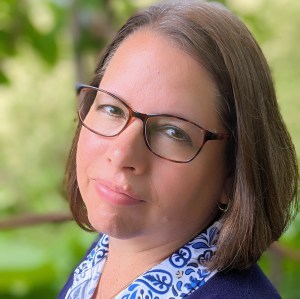
Happy May! Welcome to The Burning Hearth! Whether you are a first time visitor or a regular, I’m happy you’ve found your way here for this interview with my fellow Wisconsinite, Kristin Tenor.
It’s great to have a guest whom I’ve actually met, in person. Two times, to be exact. So when I say that Kristin has an infectious smile, an upbeat attitude, and a generous nature, these are not things I’ve gleaned from email exchanges or zoom but rather what I’ve witnessed and experienced in her presence. But it would be a mistake to mistake Kristin as a happy-go-lucky-doesn’t-have-to-deal-with-the-tough-stuff kind of person. Kristin exhibits a light exterior, which is buoyed by a deep interior as evidenced by the title of, and the stories contained within, her debut chapbook, This is How They Mourn, the 2024 winner of Thirty West Publishing House’s 8th Wavelengths Contest.
I’m excited to share Kristin’s interview with you. I’m certain it will leave you thinking about the themes of loss and grief, as well as the craft and process of writing. I hope, weather permitting, you can sit outside among the blooming flowers (lilacs, my fav) and the newly leafed trees (weeping willow and oak, love) as you settle in for an interview that is sure to stay with you long after you’ve finished reading it.
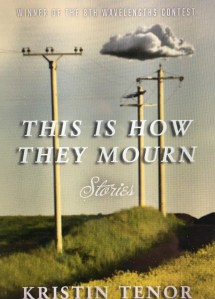
This is How They Mourn by Kristin Tenor
BH: Let me begin by thanking you for stopping by The Burning Hearth. Let’s start the interview by talking about your chapbook This Is How They Mourn. As noted in the introduction, This Is How They Mourn, was the 2024 winner of Thirty West Publishing House’s 8th Wavelengths Contest. Even though I have congratulated you personally, let me do so again here. I read your book when it first came out and again to prepare for this interview. I found a question I wrote on the last page after my first reading (I had forgotten about writing it until I read it again), and I found that the question still resonated with me, so I’m going to ask it.
Beauty resonates in all the sad corners of This Is How They Mourn. Without fail, that beauty evokes compassion from the reader. Your ability to write it with complexity and humanity leads me to believe you deeply contemplate what it means to inhabit this space physically and emotionally. What attracts you to the face and body of loss, grief, despair, regret?
Kristin: Thanks so much for your kind words, Constance, and your invitation to join you at The Burning Hearth. As always, it’s a pleasure to be in conversation with you.
This is such a thought-provoking question. I think what intrigues me most about loss, grief, despair, and regret is how they connect us as human beings. In Edwidge Danticat’s wonderful craft book, The Art of Death: Writing the Final Story (Graywolf Press, 2017), she says, “We cannot write about death without writing about life.” Every story told since the beginning of time has been one of transition and transformation. Regardless of our age, gender, identity, education, political or philosophical leanings, religious beliefs or agnosticism, we continually go through the cycle of loss. Time and time again, we’re faced with the challenge of shedding one life in order to rebirth ourselves as we draw closer and closer to our ultimate calling to forgive and love one another (and ourselves) unconditionally. The liminal space that exists between loss and what remains is where empathy and compassion reside, and so often we seem to forget that—myself, included. Some may call me an idealist, but it’s always been my hope that the stories I write and share serve as a reminder of that truth. It’d be nice for us all not to feel so alone on that journey.
BH: “Pancakes” is perhaps my favorite story in the collection, if for no other reason (but there are others), than the last line. The gravatas, hits. The visual of the pancakes being tossed in the air, hits. All of this circling back to the Ophelia-esque mother, anchor tied to her ankle, hits. I don’t have a specific question about this piece, but I would love to have you speak to its origin, and to your crafting of it.
Kristin: As with most stories I write, this piece went through several revisions before it coalesced. The initial draft centered around a woman watching her partner make pancakes the morning after they’d had a disagreement, which somehow triggered the memory of the woman’s father also making pancakes when she was a child. However, the woman’s voice seemed very distant. I wrote a few more drafts but continued to hit the same roadblocks and eventually set the story aside for a while. A few months later, I attended a writing retreat in Grand Lake, Colorado, facilitated by Kathy Fish and Nancy Stohlman. During one of our workshops, Kathy encouraged us to write a narrative from a place of wonder, or, as she calls it, ‘perhapsing.’ This prompted me to explore what the narrator didn’t know or wanted to better understand about the day her mother chose to leave their family. Once I wrote the opening, “She doesn’t know why…” the narrator’s propulsive stream-of-consciousness took over, and the rest fell onto the page rather quickly.
While writing the piece, the image of the mother lying in the bottom of the boat with the anchor tied around her ankle haunted me for days and, honestly, still does. Much like the narrator, I keep asking why—why do such a thing? Did her obligations as a wife and mother weigh her down? Did she feel somehow betrayed—or guilty? Did she suffer from an undiagnosed mental illness? Maybe. I’m not sure. And the last line (which I won’t give away here) has also stayed with me. I know at some point there will be more stories written about these girls.
Kristin Tenor reads “Pancakes”
BH: Another gem is “And All the Heavens Are in Disarray.” At first, I thought this was a 100-word story, but I counted and discovered it is barely over 50. Dang! There is so much packed into such a small space that yet consists of the sky. I so want to know the seed that began this story. Was it terminal illness? The constellations?
Kristin: I actually wrote “And All the Heavens Are in Disarray” in response to a writing prompt provided by the editors of Press 53 and Prime Number Magazine for their free, monthly 53-Word Story Contest. The prompt was to write a story about a shell. I remember free-associating the different synonyms for the word ‘shell’ and paused at ‘carapace’, which then led me down a rabbit hole to ‘crab-like’ and finally the dualistic definition of ‘Cancer.’ Soon the constellations and the couple lying in the hospital bed counting the holes in the ceiling tiles emerged.
Although some writers might consider writing within such tight constraints restrictive, I often find the opposite to be true. The pressure to remain within the boundaries seems to trigger a creative response, which ironically seems limitless. I’m always grateful when quiet moments such as the one in this piece find their way onto the page.
Kristin Tenor reads “And All the Heavens Are in Disarray”
BH: Was “And All the Heavens Are in Disarray” originally short, or was it a series of cuts and revisions?
Kristin: Yes, this piece originated as a microfiction piece, probably because I had the 53-word limit in mind from the get-go. However, I did spend quite a bit of time choosing which details felt most authentic to the scene without falling too deep into cliché. I wanted to ensure the details and white space felt balanced yet carried enough weight so that a lasting emotional connection could be made with the reader.
BH: Now that you’ve submitted a chapbook to a contest and won, what advice would you give someone about entering contests?
Kristin: Be selective and understand the aesthetics of the journal and/or press hosting the contest. Do your research—read the work of the authors who have won the contest in the past as well as that of the guest judge. Don’t send work that hasn’t gone through revision. Make sure your manuscript adheres to the contest guidelines (trust they are there for a reason). Be patient—both with yourself and your work. Sometimes the selection process may take months. No news generally means your submission is still under consideration. Allow yourself to be cautiously optimistic but also keep yourself grounded by working on another project while you wait. Be proud of the work you’ve done. Celebrate no matter the outcome.
When I submitted my manuscript to the 8th Wavelengths Chapbook Contest, I saw it not only as a possible chance to publish my debut chapbook, but also as an opportunity to learn more about the process of publishing a book-length collection. My experience with the editors at Thirty West Publishing House has been an exceptional one, and I’m grateful for the time and support they’ve given (and continue to give) to both me and my work.
BH: I would like to switch gears here. Between the time I invited you to be a guest at TBH and now, you’ve revamped your website. And what a lovely website at that. A writer friend recently asked me how I felt about having a website, as she is considering the leap. Knowing I was doing this interview with you, I thought you might be the perfect person to add to this conversation. What benefits have you found in having a website?
Kristin: Besides being a writer/editor, I also have a bachelor’s degree with an emphasis in marketing/management from Marquette University, which has come in handy while figuring out how best to establish an online presence. So much of marketing is about branding and communicating a product’s perceived value with the consumer—in this case, the product being the writer and their writing, which sometimes feels unnerving, especially for someone who’d rather spend time with their characters (raises hand). And yet, we live in the digital age, and this is how many readers/editors/agents discover our work.
I’ve always considered my author website to be my professional calling card. It’s a place where I can share recent publication news, curate a list of select stories and interviews, let readers know about upcoming author events, as well as provide purchasing information about my recent chapbook, This Is How They Mourn. It also allows readers and/or editors the opportunity to reach me via the contact form.
Obviously, websites require an investment (both time and money); however, I find it a worthwhile one. What’s also beneficial about having your own website is that you control and own the content, unlike social media posts profiting you know who.
Some writers I know hire web designers to build and maintain their websites, but platforms such as WordPress, Wix, and Weebly include an array of built-in templates and are fairly versatile and user-friendly. I created my website using WordPress.
BH: Many of my readers might not know that you are the Reviews Editor at Story. Please take a moment to talk about Story, and how (if indeed it has) your role as Reviews Editor has enhanced your writing.
Kristin: Story is a tri-annual print magazine that exclusively publishes short fiction. The magazine was founded in 1931 by Martha Foley and her husband Whit Burnett, although it’s gone through a few iterations since then. In 2018, Michael Nye revived Story as part of a non-profit, independent arts organization based in Columbus, Ohio. Also, many stories that originally appeared in Story have gone on to be reprinted in editions of The Best American Short Stories, The Pushcart Prize, and The O. Henry Prize, which is fantastic.
This past January, Story began publishing short story collection reviews on our magazine’s website, along with accompanying author interviews. It’s been so gratifying to recognize and celebrate the many wonderful short story collections published each year, especially those written by our former contributors.
And yes, I’d say my editorial work at Story has enhanced the way I approach and edit my own work. It’s also made me a more patient and resilient writer. Story receives several thousand submissions each year, and only a few dozen make it through to publication. This doesn’t necessarily mean the stories we passed on were poorly written. Rather, they weren’t a good fit for our publication needs at the time we read them. Understanding how subjective the entire process is definitely helps keep everything in perspective.
BH: What’s next on the horizon for you?
Kristin: I’m currently working on a linked short story collection where all the stories take place on the day man first walked on the moon. Although these characters share the common experience of witnessing history in the making, they also each grapple with their own unique set of challenges. I’ve always been intrigued as to how the ordinary details of such a life-changing, historic event have a way of imprinting themselves on one’s memory. We often associate the moon landing with families huddled around their television sets; and yet, what else happened that day or evening? This juxtaposition between the ordinary and extraordinary fascinates me to no end.
BH: Thanks again for this wonderful interview. Before signing off, three getting-to-know-you-better questions.
1. What’s your favorite season for writing? Why? Being a life-long Midwesterner, I’d say winter. It’s the cozy time of year when things slow down and become more insular. It’s also much easier to stay planted at the desk when it’s -20º F outside.
2. What is the one craft book you turn to time and again? Why? Naming the World and Other Exercises for the Creative Writer, edited by Bret Anthony Johnston (Random House, 2007) because it has a nice selection of writing exercises written by a variety of accomplished authors including Dorothy Allison, Elizabeth McCracken, Ann Packer, Paul Lisicky, among others. There’s also a lengthy list of daily warm-up exercises near the end of the book that’s been particularly helpful on days when I need a spark to get going.
3. Who is the one deceased author you would love to be able to ask a question to? What is the question? Jane Kenyon, although it’d be difficult to limit myself to just one question. I’m sure they’d all be some variation of “Could you please teach me…” To which, I imagine she’d smile and say, “Come, let’s take a walk around the pond.”
Kristin Tenor finds inspiration in life’s quiet details and believes in their power to illuminate the extraordinary. She is the author of the flash fiction chapbook This Is How They Mourn (Thirty West Publishing House, 2024), which explores the liminal spaces that exist between unexpected loss and what remains. Her fiction has appeared in Best Microfiction 2024, Wigleaf, Bending Genres, 100 Word Story, and various other literary journals and anthologies. Kristin’s work has also been nominated for Best of the Net, Best Small Fictions, and the Pushcart Prize, as well as longlisted for the Wigleaf Top 50. She currently serves as the reviews editor at Story.
Thank you again for stopping by The Burning Hearth. I hope you enjoyed my interview with Kristin, and if you haven’t already read This Is How They Mourn, I hope it is now on your summer reading list.
Up next is Andrew Porter. We will be discussing his new book, The Imagined Life (Knopf, 2025), and other writerly things.
Until then, stay well and get outside. Nature is calling you!

Constance
 Constance Malloy
Such a pleasure, Constance! Thank you!
LikeLike
My absolute pleasure!!!
LikeLiked by 1 person