
Shze-Hui Tjoa
Imagine you just finished a walk through a forest filled with aspens trembling in the cool evening breeze of a mid-August day. You see my cabin (your destination) ahead, and you consult your invitation. It simply asks that you arrive by sunset. The pink-tinted sky signals you’re on time, so you walk the last several feet to the door and knock.
“Hello,” I say, upon opening the door. “I’m so glad you found your way.”
I invite you in. We pass through the foyer into the living room where a woman is seated next to the hearth. The fire’s amber light fills the room as the day gives way to night.
“Welcome to The Burning Hearth,” I say and indicate for you to sit in a chair to my left.
I gesture to my right and say, “This is Shze-Hui Tjoa, the author of The Story Game. I’m delighted to introduce her to you, and I’m glad you could join us while we discuss her book.”
“Shze-Hui’s book is crazy good!” I explain as I pour us all a cup of tea. “It’s been a long time since I read a book in one sitting, which I did with The Story Game. It captured and held my attention from beginning to end.”
“Every turn of the page made me curious and filled me with a multitude of questions,” I say, passing you the honey. “I knew the minute I closed her book, I wanted to interview her, and I’m honored beyond measure that she agreed to join me hearthside,”
I sit down and smile at Shze-Hui, and then I turn to you. “You’re in for a real treat,” I say. “Shze-Hui is approaching this interview with an unparalleled openness toward the questions I want to ask her, and with a generosity of spirit to answer those questions that surpasses my expectations.”
I take a sip of tea and reflect for a moment. “I feel as though my interview with Shze-Hui,” I continue, “will be like a dance, choreographed to elicit a search for meaning in events and ideas and understandings that on the surface will seem only to contain darkness; yet, when the darkness is braved, I believe light will break through, moving the dance from one of trauma and grief and the erasure of self, into one of recovery and release and the rediscovery of self.”
I stir the fire and add another log.
“Let’s begin,” I say to Shze-Hui, as I relax back into my chair.
Hearthside
with
Shze-Hui Tjoa
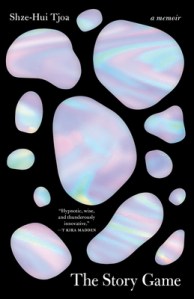
The Story Game
Burning Hearth: Let me begin by saying I’m delighted you agreed to this interview, Shze-Hui. Your memoir, The Story Game (Tin House, 2024), evoked so many questions in me that I believe I would have burst without the opportunity to ask you some of them. So, I thank you for sparing me that fate and for sharing your story with the readers of The Burning Hearth.
I have a deck of Angel Cards. Each card is a half-inch wide and two inches long. On each card is a drawing that represents the single word of contemplation that is written on it. I keep the deck in a bowl where I will pick one on days when I’m a bit scattered and in need of focus or, as I did before reading The Story Game, when I’m in need of a bookmark. I randomly drew a card with a tiny angel peering through a telescope to a faraway island. Exploration is the word written on the card. The Story Game is about exploration but not of things far and away in the distance, but rather about things that are so close they are hard to see. Things that are lost to a darkness that is both external and internal. Things that are lost to a past that exist in what appears to be an internal abyss that is quite possibly too deep to allow in light.
I, too, am a victim of trauma and live with managing my PTSD. Unlike you, my memory was hyper-intact and in full technicolor, so I cannot imagine walking around with this gaping hole in my memory. Did exploring and excavating your memories present yet another trauma? Or did their recovery, which brought into the light your understanding of both why you had blocked your memories and why you had developed an outsized need to control others, bring to you a sense of relief?
Shze-Hui: “Exploration” is exactly how I would describe the spirit of The Story Game! And how cool that you picked that Angel Card as a companion to my book – in my birth chart, the explorer Sagittarius is the sign that rules my career and public life. As I type this, I’m smiling to myself at the random point of connection between our two rituals.
I’m so curious about what you said here – that with you, your memory was hyper-intact and in full technicolor. For me, I retained the verbal descriptors of what I had gone through – for example, I could have factually and mechanically told another person, “I played the piano every day as a child”. But behind those words was a massive blank space, because I had no memory of what the experience had actually felt like – no sense memory, and no visual memory or “picture in my head” to accompany the words. Recovering those visceral memories of being verbally and physically dominated was very painful; in fact, it was probably the most psychologically painful thing that I have done, so far in my life. I think I was only able to persist in it because of the guidance and companionship of my very capable psychoanalyst.
I’m immensely grateful that I didn’t give up on excavating the memories, though. The process really hurt, but eventually it saved me. It gave me… well, I wouldn’t say “relief” exactly, but an authentic sense of who I am. As someone who dissociates easily, I had never had any trouble disconnecting and moving on from my past. But writing The Story Game gave me back the selfhood that was contained in all those old memories; I got back the pain of the past, but also my old pleasures, interests, and personality traits that were contained in those years. It felt like becoming a real person again, after having been empty for many years.
Burning Hearth: You begin your memoir with histories of colonization and of the colonized. I am fascinated by the languages the colonizer provides its subjects. One of those being, the language of justification. A language meant to make everyone feel comfortable about their position, whether they are the subjugator or the subjugated. Therefore, the language of justification is also one of manipulation.
In the chapter titled “Hui’s Second Story, On Being in Love with a White Man” you write, “Power, after all, is that secret, glinting thread hidden within the fabric of experience: almost invisible to the naked eye, even as it holds together the many pieces of the world.”
I understand this chapter is about the complex situation of your marriage, but it made me think of more subtle forms of colonization, mainly of how dysfunctional parents colonize their children. Perhaps, dysfunction is the colonizer of both the parent and the child, and the child is, perhaps unwittingly, being indoctrinated. Was there a language that was given to you to justify what you endured while studying piano? If so, how did that language become a “…secret glinting thread hidden within the fabric of [your] experience…?”
Shze-Hui: I love what you said here: that parental dysfunction can be a refraction of the kind of dehumanizing relationship that arises through colonization. And that the dysfunctional dynamic itself can be the colonizer of both parent and child, who unwittingly become players in its game, or take on ready-made roles in its matrix of power… I think that’s very true.
In my own experience, the link between these two systems (colonialism and parenthood) was a kind of extractive, or maybe you could say exploitative, dynamic. Where one person treated the other as a pure resource to be used – trying to extract all their material and psychological gifts for their own purposes, without any considerations of sustainability, or the other person’s autonomous desires, or their happiness. And I don’t know that my parents were even conscious of having done this to me, when they were doing it – after all, they loved me very deeply too, and I felt that the whole time. But sometimes people just take on the spirit of the system that they live in, you know? And they unwittingly regurgitate and further it, for their own psychological survival. My parents had to survive a relentless system too – the punitive system of a furiously modernizing nation-state (Singapore), which was itself trying to survive in the often cruel, inhumane, and very transparently inequitable system of the West’s global post-war empire. So my parents did what they did to me out of love; they gave me what they believed I would need to survive this system too. I feel like they loved me with all the best tools of their reality.
As for your question: I think that chiefly, my parents’ language framed perfection as the bare minimum for survival. Failure was not an option in the language that they gave me; excellence was the only acceptable standard to aim for, as a person from Southeast Asia trying to make it in the broader world. I’m still unlearning a lot of that in different areas of my life. Like in my writing career – by aiming for unusual goals besides conventional prestige or success, like authenticity, or connections, or new experiences. Or in my friendships and relationships – by taking more risks and speaking my mind, instead of appeasing other people. At the same time, I’m also grateful that my parents bequeathed me the ability to be excellent on demand, because it can sometimes come in handy. It’s still a useful survival tool.
Burning Hearth: In that same chapter you also write about an essay you read shortly after you and your husband were married. It was by another Singaporean woman and written in the form of a letter to her younger self. You write, “And what it amounted to–in not so many words—was an instruction manual for decolonizing one’s mind from the inside out.”
Is decolonization a lifelong pursuit?
Shze-Hui: I feel like I can only tell you the answer to this question at the end of my lifetime! But I suspect that for me, decolonization will be a very long and slow process, because it involves learning how to live with the part of myself that has internalized the role of the colonizer.
I don’t think it’s always so simple and straightforward, right, where people are either pure victims or pure oppressors, based on the identities they were born into? I believe in the project of global decolonization with all my heart – and especially in the last year or so, I have taken quite a few risks to work towards it with both my career and my communities. And yet, I know that there is a part of me that knows how to think like a colonizer too – especially because I grew up in Singapore, a country that has never fully repudiated the system of empire and racism that it was once subjugated under (ideologically, anyway; I would say that materially, we have freed ourselves extremely successfully through our economic achievements, and I’m proud of that).
I suspect that the spirit of the colonizer will always be a part of me, or at least something that I have proximity to and can step into quite easily, at will. And maybe the goal isn’t to get rid of this “shadow side” of my psyche completely, right? But simply to be curious about its lingering presence and ask: What else can I use my facility with this power dynamic for, other than to oppress and dehumanize other people without truly seeing them, or respecting their autonomy? What else can a dynamic of inequality be good for – if I treat it like a game that can be played sometimes, rather than the horrendous and only ruling system for all life on earth? I suspect that for me at least – as a person whose background bridges both the Global South and North – there can be no freedom without confronting this question honestly.
Burning Hearth: I studied dance from the age of 9 on. In college, I studied choreography and went on to have a rather successful career, first as a dancer and choreographer, and then as a teacher. I owned a studio for the last ten years of my career. By no means a prodigy of dance, I enjoyed it immensely and reaped many benefits from it. But there was a dark underbelly to my dancing. I grew up in an emotionally violent home and, for as much as I loved dancing, it was my escape. Four nights a week, I was at the studio where I felt safe with my instructors. I concentrated so completely during my classes that I was able to free my mind of its worries and fears. Most importantly, through movement, I was able to purge the energy of those worries and fears, along with the pent-up anger and frustration coursing through my system, which I was not allowed to express in my home. My body saved me. Your body rescued you.
Psychosomatically, or otherwise, you developed extreme scoliosis, which ended your career as a pianist. That it so often takes such extreme duress for a person’s suffering to be noticed is rather mind boggling to me. However, when the stakes are so high many things are overlooked. That same body that was crumpling under the pressure of your studies, and the manner in which you studied (isolated in a dark room for many hours a day for several years), is the same body that through therapy, you were able to grant it its voice and listen to its pain. You turn body into Body in your book and allow the reader to hear its voice as well. What was it like for you when you first started listening to your body’s story? What were the challenges of incorporating Body’s story into your body?
Shze-Hui: Thank you for telling me about your dance background! I love that we have this in common – that our bodies saved us. It fills me with awe to think of how capable, assertive, and clever people’s bodies can be in times of duress. I’m very moved to hear about how your body took you to a safe place when you needed one.
I first started listening to my body at around age 28, which was when I wrote “The Story of Body” (as detailed in the book). I think that the first big struggle for me was to acknowledge that my body even had a voice at all – as distinct from the voice of my mind. In order to do that, I had to take a good, honest look at the situations in my life where my mind was telling me one story about who I was, but my body was enacting another reality – for example, when my mind wanted me to believe that I was an adventurous traveller, but my body knew that I spent most of my holiday in the Baltics immobile in a tent. Or when my mind said that I had the life of a cosmopolitan young professional in London – but my body knew that tallied up quantitatively, that its most frequently-done activity in that city was actually lying at home in bed, staring at the ceiling. In my twenties, I had a lot of difficulty admitting to myself that the daily experiences of my feet, hands, arms, torso, neck, spine, legs, haunches, etc. were the story of who I was, as a human being.
It sounds so basic and obvious, right? But I think that it was hard for me to accept because if I did, then I would have to grieve all the opportunities for living – really living and sensing and thriving in the body – that I’d lost out on over the years. I’d spent so much time cooped up and stationary in small rooms – playing the piano in Singapore, then again while studying at university, and then again at my jobs – all the while telling myself that these were prestigious accomplishments that made me a successful person. It was hard to admit to myself that they were, in fact, also lost years where I wasn’t fully living as I wanted to.
Burning Hearth: I love the image of you dancing to music towards the end of your book. “My body is dancing, and flying, and free,” you write. “My body is so very alive.” My heart was so full of joy for you that you could once again let music inside and feel it pulsing through you.
But this comes long after you give your body its voice and share, “Body just sits still on the piano stool. It stops wishing that it was somewhere else.”
If those two lines don’t devastate the reader enough, you wrench the reader’s heart by adding, “Body just tries to survive.”
I wonder, do you still play the piano? Can you/do you find as much joy in playing music as you do in listening and dancing to it?
Shze-Hui: I don’t play the piano anymore. But even as I write this, I’m thinking, “Wait, that’s not true” – because I did go back to playing the piano briefly, during the four-month period when I was revising The Story Game to query agents. Every few days, I would take the tube in London to a piano shop where they rent out rooms, and I would practice short pieces from Debussy’s Children’s Corner suite. It made me feel good to track my own improvement – even though realistically speaking, the pieces were very easy compared to what I used to play at age eleven or twelve. I guess I needed something from that old pianist self to get through the revision process … maybe I needed to feel the satisfaction of improvement, to help me cope with the indignity of being critiqued.
This question – about whether I will ever play the piano again – is actually a live one for me at the moment. I am still thinking about it, so I don’t know if I have an answer for you yet. There’s something about mastering a skill with my hands that makes me feel full and joyful and excited to be alive – so much so that outside of writing, I’m now transitioning towards to doing physical odd-jobs for the summer, like volunteering as a barista at the zero-waste cooperative in my neighborhood. I think, though, that I’d like to play in a team if I ever do play music again. That was the most fulfilling part of it for me – experiencing the thrill of many people’s psyches/bodies firing all at once, and contributing my many hours of solo training towards a collective creative pursuit.
Burning Hearth: I’m curious as to whether or not you are in contact with other people who were put through a similar situation? I can’t imagine any child surviving this without extreme trauma. Do you know any prodigies that have continued on into adulthood who are fully functioning and thriving in their careers and personal lives?
Shze-Hui: Oh wow. Reading this, I realize how much I wanted to be asked this question, about the other kids in the school. Thank you for bringing it up – you’re actually the only interviewer who’s asked me about this, so far. I wonder if the similarities in our career backgrounds led you towards it?
I am friends with one of the other people from my conservatory age-group (or “batch”, as we say in Singapore). I consider her a close friend, and I feel grateful for her continued presence in my life – even as I recognize that her story or feelings about what happened in the school may be completely different from my own. She still plays the piano extremely skillfully – with some pieces, she seems (to me) to have a beat-by-beat somatic memory for how we used to perform them as children, down to the exact gestures of her head and hands. The times when I’ve seen her play like this, I felt like we were stepping through a portal together and back in the past.
Of my batchmates, only one person whom I know of went on to become a full-time classical musician. He has had a very impressive international career. But who knows, right – is that the same thing as being a fully-functioning and thriving adult? Only he would be able to tell you the answer to this, I feel. I often wish that I could find this person again, to ask him how things have played out in his life since we were kids. I’ve watched a few videos of him performing in orchestras or ensembles, and read some of what he’s written online about his life experiences… it makes me wonder if he’s been on a big journey of personal growth too, like I have.
You know, in many ways The Story Game is a book where I make up for what I didn’t get as a child – specifically, a good experience of being someone’s sibling. I wrote it to regift myself a kind of love that I didn’t actually get to have. Sometimes, I wonder whether it’d be possible to write another book to make up for what I missed out on in the piano conservatory, with my batchmates… I miss the version of reality where, in a healthier and less toxic learning environment, we could have been equal but different members of a team achieving something great together. I miss that unlived version of my life.
Burning Hearth: There are many things about my study of dance, choreography in particular, that influence my writing. What, if anything, carries over from your musical background into your writing?
Shze-Hui: Lots! In fact, I think that writing is basically another form of musical production, for me. When I write, the main sense that I’m using is my hearing and not my vision, if that makes sense; I’m listening to how the words sound in my head as I type, rather than primarily viewing them with my eyes. Sometimes, I end up over-punctuating my lines for that reason – because I’m imagining how the sounds would be delivered in the physical realm by my body, structured by my lung capacity and the flow of my breath, as well as by the movements of my stomach, diaphragm, and throat. In general, I write as I’d speak – or sing. Sometimes I wonder if I write mainly because I gave up music as a child.
Possibly another thing that carries over is my extreme sense of control. I like things to be very precise and neat when I write – and I suspect that’s another holdover from my days of marking scores, studying other pianists’ recordings, and being made to watch videotapes of my own performances to critique them, or correct myself, on a second-by-second basis. I think that so far in my life, creativity has been a process of learning how to let go and let things get a bit messy or weird. Learning how to let all that ugly stuff be “me”, as well.
On a separate note, I often think about how I’m unlikely to ever produce as much beauty again, as I did when I was a child – just in terms of sheer volume, you know? That era when my body was a finely-tuned machine for the daily creation of aesthetic beauty… sometimes it can feel like that period is over, and it saddens me. But I wonder if, and how, the echoes of that time might still catch up to me.
Burning Hearth: I love that you take the reader inside the dark room with you and your sister, Nin. It proved to be a brilliant way of placing the reader into your darkness with you. I felt your suffocation of space and place, while at the same time, I unexpectedly grew comfortable in the darkness with the two of you. At times I felt a bit sneaky, as if I were eavesdropping, but then the room was so dark, I was sure you didn’t know I was there. This is, in my opinion, a masterful approach to telling your story. I have to believe you came to understand your need to control on an even deeper level while writing these conversations between you and Nin. If so, I’m curious what it is like for you to read these scenes now?
Shze-Hui: I like what you said about feeling like an eavesdropper. When I read, I feel that there are mental spaces where I can only go if the author isn’t addressing me directly in the text, or looking straight at me. In hindsight, I suppose I must have tried to recreate that experience for my readers.
To be one hundred percent honest with you, I am not a big re-reader of my work because it can cause me to feel anxious and overthink. So I haven’t re-read those scenes from start to finish, since publication. I am glad, though, that the imaginary conversations between me and Nin are set down on a page now, and no longer weighing on my unconscious mind as fantasies of what could have been. Those fantasies took up a lot of mental space over the years. And now that I’m free of them, I have so much more energy for other kinds of relationships in my life. In a way, it feels good to have rejected the entire “game” of chasing that my sister’s silent treatment imposed on me – because to put it very bluntly, I am now at a point where I can authentically decide whether I even like her or not. Our relationship is now real.
Burning Hearth: Before asking my remaining questions, I just want to say what a pleasure it has been to interview you. Definitely, a highlight of my year.
I want to end our interview with your chapter titled “Hui’s Third Story, The Sad Girl Variations.” I interrupted my reading to have my 15-year-old daughter read this chapter. She is the only person at her school (to our knowledge) without a smartphone, and she is not allowed on any social media sites. To borrow an analogy, she has become the sober one in the room. She and I talk about the subject of this chapter all the time. Mainly, how many of her peers, girls in particular, are not projecting their true selves. You sum this up with acute awareness.
You write,
“Perhaps another way to put it is this: the Sad Girl, unlike me, was ardent and alive. She moped a lot in the pictures, sure. She starved and hurt and writhed and swooned. But all this suffering was, ultimately, on account of her passionately wanting things–like attention or even devotion.”
A few paragraphs later you add,
“Her crying face was, functionally, a kind of decoy. And being such a culturally valued decoy, it occupied all the discursive space that depression should have held for us. Caused us to grow watchful for all the wrong signs: for tears not tiredness; excess, not nonchalance. For beguiling visions in long peasant skirts, floating about in silky despondence. Using their suffering to make a point.”
Then, you suggest,
“But consider the new feminine ideal that is taking her place: the glowing, pony-tailed woman of wellness, holding yoga poses in her breathable tights. Wholesomely, admirably strong and trim; diligently Thermomixing her way to health.”
In the next paragraph you question,
“She looks so uniformly, persistently euphoric that I can’t help but wonder: is she to today’s teenagers what the Sad Girl once was to me? A red herring towering over us all, holding out half-truths about mental health?”
There are so many questions I could ask but I will refrain and ask only two.
How does one, do you think, discover their true identity when they are allowed and encouraged to affect an identity, and then driven to compete on social media over who can most successfully sale that identity?
Shze-Hui: There’s so much depth in this question! And I’m in awe of how you framed it via your own experiences as a parent. For my second book, I’m trying to learn how to ask questions of others without losing my sense of self, so watching you work here has been very enlightening for me.
So – I am actually an avid user of social media. And I feel grateful for how it keeps me connected with my family and friends in Singapore, even though I live outside the country now. Personally, I feel the social media self that I present – particularly to promote my book as a product in this moment – is a valid and “real” side of me, just as my flesh-and-blood self that moves through the physical world is also the “real” me. As is the chatty, but slightly erudite, self that I’m presenting to you now in this interview; as is the can’t-be-arsed self that I use to go to the grocery store; as is the playful and silly self that I bring out around my close friends or husband. All of these are versions of me that I accept and, on my best days, find pleasure in. Even though many of them are radically unalike – originating in the unselfconsciousness of childhood, for example, versus the more conventionally prestigious terrain of my early adult life. But I think of them all as equally valid personas that can coexist, and that I can code-switch between depending on what I need.
In my own history, actually, the difficulty came when I lost the ability to move fluidly between these different selves, and felt like one of the personas “owned” me fully. As you’ll know from The Story Game, I spent a large part of my teenage and early adult life feeling trapped within the persona of the golden child, or the perfect intellectual achiever. And it was a horrible, emptying, dehumanizing feeling. It felt like being a non-person; almost as if someone had pre-determined who I should be, so that my “true” self was eaten up by other people’s fantasies. But once I had written The Story Game, and gained the ability to move in and out of this golden child persona at will, I stopped resenting it so much. And nowadays, it’s often this version of me that I will rotate out and deploy on social media, to connect easily with others and build meaningful relationships. She’s very useful, this “high achiever” self! I feel increasingly grateful that she exists, now that she doesn’t define the borders of my whole world anymore.
I guess what I’m trying to say is: for me, discovering my “true identity” was a process of coming to accept all the different versions of me equally – even the ones that were more “affected”, so to speak, or that had originally been created to make me hyper-consumable or -palatable to others. First of all, I had to figure out how to break past these “false” or more saleable selves, to access the possibilities beyond them. But afterwards, it was the act of integrating these “false” selves back into my person again – and learning how to live with them harmoniously – that started to heal me.
Burning Hearth: Do you think it drives one further from their true self to not be seen or to be falsely seen?
Shze-Hui: What a profound question. It makes me think of two things. The first is this famous line that Donald Winnicott wrote in one of his essays – “It is a joy to be hidden and a disaster not to be found.” I like this quote so much that I pinned it above my writing desk during my final year of constructing The Story Game. I also wrote out and pinned another quote from the same essay – which I’ll share here too, because I find it meaningful:
“At the centre of each person is an incommunicado element, and this is sacred and most worthy of preservation… the traumatic experiences that lead to the organization of primitive defences belong to the threat to [this] isolated core, the threat of its being found, altered, communicated with. The defence consists in a further hiding of the secret self, even in the extreme to its projection and to its endless dissemination…
[This] non-communicating central self, forever immune from the reality principle, is forever silent… It belongs to being alive.”
The second thing that I thought of, when I read your question, is a conversation that I had recently with the memoirist Jeannie Vanasco. Jeannie and I have both written nonfiction about being subjected to the silent treatment by a close family member. And we were talking about how – although the silent treatment can feel incredibly eviscerating and demeaning in the moment – it can also goad a person into undertaking new, or boundary-pushing, forms of creativity and self-expression, in their bid to win a sliver of acknowledgement from the other. In that sense, not being seen can be very generative.
So I guess that my personal answer to your question is: No, not always. I think that actually, there are kinds of growth, tenacity, creativity and self-actualization that can only happen when a person isn’t fully or consistently seen, in at least a few key aspects of their life. For me, being falsely seen by my parents and siblings during most of our time together caused me to develop a kind of “secret self” – that sank deeper and deeper into the ground of my psyche like a seed, gaining potential energy and life force over the years. Until eventually, it burst out of the darkness and manifested in the authenticity – or maybe you could say assertiveness – of my writing voice. It was this prolonged experience of not being seen that gave me the secure selfhood I have now.
But I think I was also lucky to be able to show this true self to other people eventually, you know? I’m very aware that that outcome wasn’t a given. I’m grateful that the hidden seed could start germinating through my writing career, which has connected – and still is connecting – me to a whole world of people beyond my immediate family. Each day, I take the risk of stepping out to meet this world – and the people of this world save me from the “disaster” of being forever unseen, to borrow Winnicott’s language again. They save me from being destroyed, with their willingness to ask me who I am and to see me on my own terms. Thank you for doing that with this interview too, Constance! It has really been a privilege to interact with someone so skilled at asking questions, and I feel like my path has already been materially impacted by this experience of talking to you.
Shze-Hui Tjoa is a writer from Singapore who lives in Edinburgh. Her debut memoir, The Story Game (Tin House Books, 2024), is a genre-bending book about politics and storytelling, siblinghood, c-PTSD, having been a child musician, and deconstructing/finding the self. It was named one of the best books of summer by The Boston Globe, and has been featured in Electric Literature, Poets & Writers Magazine, The Rumpus, The Millions, Between the Covers podcast, and elsewhere. Shze-Hui is a nonfiction editor at the online literary journal Sundog Lit, where she works to spotlight writers from different backgrounds and bring them into conversation.
I am so grateful to Shze-Hui for agreeing to this interview. I, too, have been impacted by this experience, and I cannot thank her enough.
If you’ve enjoyed our conversation, please post and share wherever you post and share.
Up next is Kylie Mirmohamadi, followed by Andrew Porter.
On Sunday, August 25th at 2pm CST and 8pm BST, I will be doing an online reading with Scottish author Karen Jones. I will be reading from my hybrid novelette BORN OF WATER, and Karen will be reading from her ekphrastic novella-in-flash BURN IT ALL DOWN. If interested in attending, contact me for the zoom link. We would love to see you there!
Until next time,
Constance
 Constance Malloy
This was a deeply enlightening interview. It made the book even more evocative. Thank you both for your honesty and insight.
LikeLike
You are welcome, Amy! Thank you so much for reading and commenting. I’m glad this interview enhanced your reading of the book.
LikeLike