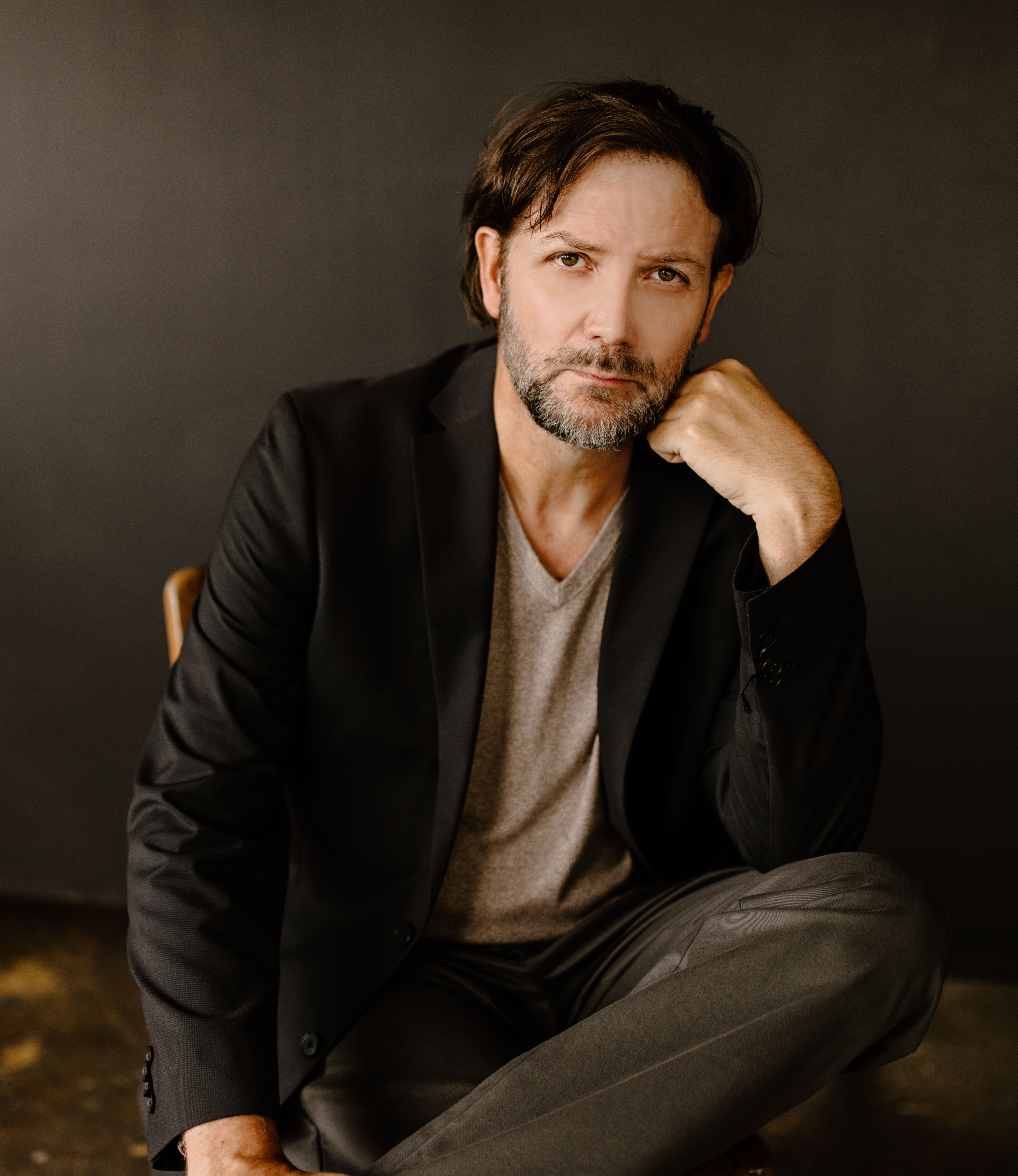
Welcome one and all to The Burning Hearth! As always, I’m so glad you are spending time hearthside with me and my guest. And today, you are in for a treat. I’m often amazed at the kindness and generosity that the authors I interview bring to the table, especially since so very few of the people I interview are people I’ve actually met. Today’s guest is no exception. Andrew Porter is someone I would describe as a true literary citizen. He is someone who gives back as much as he gets. And his latest novel, The Imagined Life (Knopf, 2025), has been getting much attention, including an interview with ABC News’s podcast The Book Case earlier this month, and reviews in The Wall Street Journal and in the Sunday New York Times Book Review.
After reading Andrew’s interview, I’m certain you’ll add The Imagined Life to your summer reading list.

BH: Andrew, I’m so honored you have agreed to be a guest at The Burning Hearth. Weclome! I’m also grateful for your patience, as it’s been over a year since I first contacted you about doing an interview. How wonderful that we finally got here and that this moment coincides with the publication of your novel The Imagined Life. Congratulations on the attention and recognition your book has been receiving thus far.
One of the reasons I’m drawn to your work is the umbrella of secrecy that hovers over many of your characters and stories. Nothing haunts quite like the familial or personal secret. The belief being that if no one acknowledges the secret, it will go away. The paradox, of course, is that the lack of acknowledgement makes the secret omnipresent. As with Steven, the protagonist of The Imagined Life, secrets carry over into every aspect of a person’s life. Secrets create mythologies in an attempt to explain what spoken truths would reveal. Secrets cause us to have misguided emotions due to misconceptions and our attempts to fill in the dark spaces of our histories. Secrets cause us to misjudge other’s behaviors in an attempt to rationalize events.
I first reached out to you after reading “Hole.” It is the first story in your collection, The Theory of Light and Matter (winner of the Flannery O’Connor Award for Short Fiction). This story has stayed with me and continues to be my favorite among your short stories. The opening still gets me.
“The hole was at the end of Tal Walker’s driveway. It’s paved over now. But twelve summers ago Tal climbed into it and never came up again.”
There is so much energy in this for me as a reader. I immediately feel that the entire story is going to be about revealing the secrets that were “paved over.” I’m in. I’m hooked. I so want to know.
Much in the same way, The Imagined Life draws me into Steven’s life, and I want to know what the secret surrounding his father’s disappearance is. This secret, which haunts Steven, propels the narrative of the book.
I would love for you to speak to how you set up the tension between the secret and the reveal. What is your gauge for knowing what and when to release to the reader so that the ending of your stories hit?
Andrew: I’ve always subscribed to Flannery O’Connor’s approach to writing fiction, which is to say, making it up (and discovering the story) as you go along. So, early on, the secret or the mystery of the story is what compels me to write it, and that’s partly where that tension comes from: my desire to discover the story. If I feel curious about what’s going to happen myself, I assume (or at least hope) the reader will too. So, in this way, I try to keep myself in the dark about the story’s secret for as long as possible. I try to stretch it out and milk the tension for as long as I can—until it just seems like it’s time. And I know that sounds a little vague, but it really is something that I think one just feels at a certain point in the writing of a story, even if you don’t quite know what the reveal will be.
BH: Now, to reveal a little secret of my own. I reached out to Jai Chakrabarti and asked him to be a guest questioner for this interview. This is a perfect time to segue to his question.
Jai: Hi Andrew! The Imagined Life seems deeply attuned to silence—to what’s left unsaid between people who love or once loved each other. That restraint feels akin to writers like William Trevor or Yasunari Kawabata, and yet it feels distinctly part of your own style. So, how do you think about “emotional minimalism” on the page, if that’s a term that resonates for you? Or, to put it another way, what’s the boundary you keep between sentiment and sentimental? Thank you for sharing this gorgeous novel with us.
Andrew: Thank you so much for the kind words and for being a guest interviewer, Jai! What a nice surprise!
As for the emotional minimalism in this novel, I think that this is partly a stylistic quality of my writing in general. I’ve always written in a fairly restrained way—whether I’m working on stories or a novel—and have always tried to write fiction that invites the reader to participate in the interpretation of what’s happening and what the characters are feeling. And in the case of this novel I was especially conscious of using that type of restraint in the chapters that take place in the past—in Steven’s childhood—as I wanted those chapters to feel very much like they were being experienced through the lens of an 11 or 12-year-old, which is to say, a perspective that is generally just observing and taking in what is happening rather than reflecting deeply on what it all means. The more restrained that child’s perspective was the more authentic it began to feel to me and also (to answer your second question) the less it seemed to risk sentimentality.
BH: I am not shy about my love of the omniscient narrator. To be honest, there were times when I was reading The Imagined Life that I was wanting the omniscient perspective. Was this always going to be a novel in the first person? If so, what made you choose the first person?
Andrew: The novel really grew out of Steven’s voice in that very short opening section of the first chapter. For a while, in fact, those two opening paragraphs were all I had of the novel. But there was something in those paragraphs—and, specifically, in Steven’s voice—that made me feel confident that there was a bigger story here and that this narrator had a story he really needed to tell. So no, I never considered a third-person omniscient perspective or even an alternating first-person perspective. This really felt from the start like one of those novels that was about one character’s personal emotional journey.
Andrew Porter reads the beginning of An Imagined Life
BH: Now, for reveal number two. This is a perfect time to segue to the second person I invited to join us in this interview, Kristin Tenor. Here’s her question.
Kristin: One thing that immediately drew me into your novel, The Imagined Life, was Steven’s voice. He somehow felt like someone I already knew, someone I cared about. In a recent interview, you said you’re interested in writing that feels honest, that a really good story for you always gives the sense of there being the presence of another soul on the other side of the words. Do you have any advice on how one captures that level of intimacy on the page? Is it simply a matter of trust? How does the writer-self stay out of the way of the character and reader making an authentic connection?
Andrew: Hello, Kristin! Wow! Another lovely surprise! And thank you so much for the wonderful question.
I think when it comes to the intimacy of a perspective, it does have a lot to do with trust, as you said. Creating a bond between the narrator (or character) and reader. In the case of this novel, I really wanted the reader to feel that the narrator, Steven, was a living, breathing person and to believe also that the events of the novel, or at least some of the events, might have happened. To put it another way, I wanted the novel to have an almost memoir-like feel to it, and for that reason I was reading a lot of nonfiction as I was writing it, essays by Joan Didion, James Baldwin, Alexander Chee, etc..
But to get back to the issue of trust, I think that the narrative voice in a first-person novel certainly contributes a lot to that sense of trust and intimacy, but I also think it has a lot to do with making sure that everything else in the story also feels authentic and honest—the setting, the characters, the actions of the characters, the dialogue, and so on.. There are so many ways to lose a reader’s trust, but I think the more you minimize those things, the more honest and authentic the writing will seem and, in turn, the more intimate it will feel.
BH: My next question was triggered by a conversation I had recently with a college-aged woman at a conference where I was a presenter.
After my class, she approached me and asked me what had made me want to be a writer. I was struck by her awareness that she has grown up during a time when children are, as she put it, “hyper-enthusiastically supported” in anything they might mention they want to do. She was earnestly trying to discern for herself if she wanted to write because of a true interest in being a writer or because of an emboldened romantic notion of what it means to be a writer.
What made you want to be a writer? Did you have any illusions about what it means to be a writer that were disabused by your mentors/teachers along the way? Do you have students who struggle with this? If so, what advice do you give them?
Andrew: My desire to be a writer really grew out of a love for the short story form. I entered college with hopes of being a filmmaker, but once I was introduced to the world of contemporary short fiction—first in a literature class, and then later in a fiction workshop—I felt that I’d found my calling, or at least my medium, the one that seemed to fit my sensibility and artistic interests best. So, early on, I wasn’t really thinking too far into the future. At first, my goal was just to get an MFA—I figured that this would give me time to develop as a writer and build a body of work—and then, after my MFA, I just approached my pursuit of writing with the attitude that I was going to try to stick it out for as long as I could without giving up. I was going to try my best to put writing at the center of my life for as long as I could or until I either lost the courage or the desire to keep doing it.
And so, in many ways, that’s the part of my own personal story that still mystifies me. I’m really not sure how I stuck with it during those five or six years after my MFA when I was getting very little in the way of positive feedback, very few positive signs that this whole writing thing was a good idea, when I was broke all the time and trying my best to patch together a living outside of writing. When it comes to my students, this is the period of time I often worry about for them—that period after college, or after their MFA—because I know how hard it is to keep going in the face of so much discouragement and rejection and how scary it can feel to keep doubling down on writing when you’re not in a structured environment (like school) that validates it. So what I try to tell them is simply to expect it—to anticipate that this will happen—because it’s something almost every writer (unless you’re incredibly lucky) has to go through. You’ll be tested, I tell them. Your commitment will be tested, and there’s almost no way around that. But in the meantime, you can go out and try to find a community of writers, a group oof likeminded people who are facing similar challenges and setbacks, and this will not only make you feel less alone in your pursuit of writing but it will strengthen your resolve.
BH: I feel this question might be frequently asked of people who transition from short to long form writing, but still, I’m curious. What were your challenges, if indeed there were any, in moving from short to long form? Also, how do you know when you have an idea that has enough energy packed into its seed to sprout into a novel?
Andrew: I think I faced a lot more challenges with my first novel, In Between Days, in part because I chose to tell that story through a limited omniscient point of view, moving between the perspectives of four different characters. There was a high degree of difficulty to that particular approach, a lot of moving parts, and at times the challenge of it was overwhelming.
With The Imagined Life, I deliberately chose to take a much less complicated approach—partly because of lessons learned from my first novel but also because I knew that simplifying the narrative scope and the plot of the story would allow me to play to my strengths and interests as a writer. I’ve never been particularly excited by plot, to be honest, though I admire a well-plotted novel. I’ve always been more drawn to character and language, to building a world and an atmosphere. So, I suppose that was the main lesson learned between my first and second novels. I learned that I could do a lot of the same things I do in my short stories—a lot of the things that I most enjoy as a writer—if I placed constraints upon myself and chose a less complicated narrative approach. And so, while there are certainly huge differences between the novel and short story forms, I do think The Imagined Life has a closer kinship to my short stories than In Between Days.
BH: Before asking my final question, I want to thank you again for sharing your time with The Burning Hearth. It’s been a pleasure having you.
So, this question is a bit whimsical. For the duration of your days on this planet, you are allowed to read the oeuvre of one author, living or dead. Who would it be and why?
Andrew: This is a very hard question to answer, and I have in fact changed my answer to this question over a dozen times in my head. But, in the end, the writer I’m going to go with is Denis Johnson, and my reasoning is that he’s a writer whose work I return to and reread frequently (and never get tired of rereading) and because he’s the author of some of my very favorite books in various genres and forms. I love his poetry; his short story collection Jesus’s Son is a top five collection for me; he’s the author of two of my very favorite novellas, Train Dreams and The Name of the World, and several of my favorite novels. He’s also written a number of terrific plays. So, based on both quality and variety, I think Johnson’s oeuvre would provide countless hours of entertainment and good reading.
ANDREW PORTER is the author of four books, including the story collections The Disappeared (Knopf) and The Theory of Light and Matter (Vintage) and the novels In Between Days (Knopf) and The Imagined Life (Knopf, 2025). A graduate of the Iowa Writers’ Workshop, he has received a Pushcart Prize, a James Michener/Copernicus Fellowship, and the Flannery O’Connor Award for Short Fiction. His work has appeared in Best American Short Stories, One Story, Ploughshares, American Short Fiction, and on Public Radio’s Selected Shorts. Currently, he teaches fiction writing and directs the creative writing program at Trinity University in San Antonio, Texas.
In addition to thanking Andrew for his time and generosity, I would also like to thank my guest questioners.
Kristin Tenor, the author of This is How They Mourn. Click Here to visit her website, and click Here to read The Burning Hearth’s interview with her this past May.
Jai Chakrabarti, the author of the novel A Play for the End of the World and the short story collection A Small Sacrifice for an Enormous Happiness. Click Here to visit his website. I’m happy to announce Jai has agreed to an interview with The Burning Hearth this coming fall. I can promise, you won’t want to miss it.
Up next at TBH is an interview with my fellow Top Shelfer ( my writing group), Al Kratz. Click Here for his website. We will be talking about his latest self-publishing adventure, T is for Train, what retirement has meant for his writing, and various craft subjects.
Until then, I hope you spend some time reading all the books listed in this interview; and please share this interview, along with The Burning Hearth, on all your socials. And please don’t hesitate to leave likes and comments; and, if you’re so inclined, subscribe.
In these troubled times, I also recommend Ursula K. Le Guin’s Always Coming Home.
Peace to you all,
Constance
 Constance Malloy