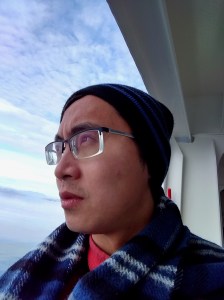
Hello, and welcome to The Burning Hearth! I am always excited to share my interviews with my readers, but sometimes my excitement gets elevated to a Kermit-going-crazy status because I’m just so jacked! This would be one of those cases.
I was introduced to Isaac Yuen in 2022 through David Naimon’s Between the Covers podcast. David’s interview with Isaac, titled “On Writing Nature, Nature Writing” was the March installment of David’s “Crafting with Ursula” series. I was transfixed the first time I heard this interview. But it was upon listening to it again, while rearranging my bedroom in April of that same year, that I was internally rearranged. While there are always many things that lead up to a personal transformation, it is the flashpoint of the transformation, the moment or event that causes us to pivot from who we were to who we are, that resonates and lives on within us. Isaac’s interview with David was nothing short of transformative for me.
Given this, I was delighted when Isaac agreed to be a featured author in my “Echoes of Le Guin” series in 2023; and, as noted above, I’m hyped to have him back! Isaac’s book Utter, Earth: Advice on Living in a More-than-Human World (West Virginia University Press, 2023), which was published a year ago today, is pure gold. Isaac’s deep caring and knowledge of the natural world is displayed with an open heart, a generosity of spirit, an ample amount of humor, and a hope that if we can all come to see our inextricable connection to the non-human inhabitants (both big and small) of this planet, then perhaps we could collectively pivot and begin cohabitating with all the creatures who call this planet home in a more equitable fashion.
I am currently sitting in the library of the Writing Center at Write On, Door County in Fish Creek, Wisconsin, and I can think of no better place to write this introduction than here. A fire is roaring to my left, and to my front and back are several windows separated by bookcases. Nestled in the woods, my view out every window is of birch and pine and shrub, of cardinal and chickadee and red squirrel, all awaiting the budding and leafing and greening of spring. All this is what I can see in a passing glance. In Utter, Earth, and this interview, Isaac steadies and deepens our gaze, and by so doing, shows us there is an abundance of wonder in this world that we are missing.
The Burning Hearth’s interview with Isaac Yuen

BH: Let me begin by thanking you for returning to The Burning Hearth. As mentioned in my introduction, you were a contributor to my “Echoes of Le Guin” series, and I’m thrilled to have you back at TBH to discuss your essay collection Utter, Earth: Advice on Living in a More-than-Human World. Before we dive into the encyclopedic romp of the natural world that is Utter, Earth, I am curious to know what turned your eye and attention towards the non-human world? How old were you when you knew you wanted to study the environment?
Isaac: Thanks for having me back at The Burning Hearth, Constance, and for the opportunity to revisit the journey that led to Utter, Earth.
I suspect my affinity for the non-human world originated–like so many others— at childhood, when there was an innate appeal in all sorts of creatures living or extinct. I was a big dinosaur kid who loved the sea. What might be different is that I tend to be stubborn with my fascinations, clinging onto them when others might have phased them out growing up.
Books were formative, naturally. I remember flipping through Richard Scarry’s Best Word Book Ever when I was four or five, not understanding much English, but following along all the anthropomorphic cats and pigs and bears going about their very human jobs of driving ambulances and peddling fruit. I remember clearly always stopping at the zoo section, tickled by how two-legged animals were visiting their four-legged kin, which in hindsight, is reflective of how we perceive the natural world, already apart. Maybe even then I was picking on the oddness of this depiction and separation, between the zoo subjects and these walking, talking proxy versions of us.
As for my forays into environmental studies, that also seemed to have originated early on, and organically. My family moved from Hong Kong to Canada when I was seven, and the awe that I felt from being dropped into a different version of nature, of fields and farmland instead of jungle and city, never quite left me. There was a lot of outdoor play, in the garden, in the dark loam, steeped in the scents and textures of life up close. That first year we also visited an exhibition that introduced me to the concept of recycling, the plight of the ozone layer, and the importance of protecting the environment. The notion of an ethic of care toward the world and its inhabitants had felt right, as did the idea that each of us can make a positive difference in shaping our collective future. It was an empowering feeling for a kid. Again, being stubborn, I still cling to that.
BH: Your deep passion and obvious love for this life and the planet and all its inhabitants flows from your writing, which, to me at least, is imbued with a generous spirit who wants to share and educate. In Utter, Earth, you intertwine so much youthful delight and whimsy with (what appears to be) inexhaustible knowledge. Your wonder at all that is around you invites your reader to take delight in the wonders you generously share throughout the pages of your collection.
On a recent visit to your site (which I highly recommend readers check out), I read your interview with Shenandoah from April 2, 2024. In it you speak to the voice of Utter, Earth while responding to a question concerning what prompted you to write a full-length collection. You say:
“I think what drew me into writing a full-length collection was the voice that emerged from that essay.* It’s a little odd, slightly frenetic, prone to tangents, as if its owner (who is me but also not me) was always in a process to knit stories out of the tangle of connections found in the natural world. To fuel that voice, I found myself immersing in science journals and articles, which provided a constant stream of weird and wonderful discoveries, and delving into a child’s mentality, which contains this intrinsic fascination with the non-human, before rules and borders so neatly divided everything into nature or culture.”
*“Life Lessons from the Odd and Ancient” published in The Hopper and included in Utter, Earth.
Have you been able to escape the “rules and borders” that, as you say, “so neatly divide everything into nature or culture?” If so, how?
Isaac: The response I gave to that question in Shenandoah, as so many things are, was inspired by our favourite mutual muse, Ursula K. Le Guin, as she pondered the onset of this nature/culture divide in her essay collection Cheek by Jowl:
“Why do most children respond both to real animals and to stories about them, fascinated by and identifying with creatures that our dominant religions and ethics consider mere objects for human use – raw material for our food, subjects of scientific experiments to benefit us, amusing curiosities of the zoo and the TV nature program, pets to improve our psychological health?
… What is it the child perceives that her whole culture denies?”
Again, there’s something elemental in that affinity for the non-human I find compelling. It’s not a rational thing. Naturally in the process of growing up, we have to discard what seems superfluous as we make and remake ourselves. Decisions have to be made. Energy has to be relegated. But I think sometimes we forget things that should not be forgotten, like this primal connection so many of us understood intuitively before we learned how to sort the world into boxes.
While researching and writing Utter, Earth, I came to discover people out there having also retained this base affinity, incorporating it into their interests, their vocations, their everyday lives. I wanted to honour that spirit of communal exuberance with the book, which is not really about hey, here are all the things I the author know, but rather hey, here are all the things human beings have discovered and are continuing to discover, usually through intense effort, dedicated attention, and pure passion.
So despite Utter, Earth seeming like a work that is centered around the non-human world, it’s really more a mirror into the human one. Look at all the amazing things we have found out and how much still remains. Isn’t that wonderful?
BH: Utter, Earth is an utterly mindboggling list of creatures and plants whose existence is integral to the land and waters of this planet. Some are extinct; some are on the verge of extinction; some have mutated to survive the ever-changing environments of the earth. I love that you included a glossary (of sorts) titled “Brief Thoughts on Almost Every Mentioned, Mostly Living Thing (in Alphabetic Order).” Just to give readers an idea of the multitudinous entries, your glossary is 36 pages long. I marvel that you penned all these fun, whimsical “Brief Thoughts.” A few of my favorites:
“Alligator snapping turtle: Keep fingers, broom handles, and pineapples away from the beaked business end.“
“Bar-headed goose: Seems to prefer the head-on approach when it comes to dealing with obstacles, even if they are the Himalayas.“
“Emu: For all you history and military buffs, the Great Emu War of 1932 is essential reading.“
“Fairy penguin: Poops out glitter made from the silver scales of fish it eats. Nature, so magical.“
“Mole cricket: Males shape their burrows into speakers to carry the mating songs they sing in pure tones. This is John Cusack Say-Anything-boombox-serenade level.“
I want to believe that if people saw themselves reflected in the natural world, and vice versa, they would, by virtue of recognizing that relationship, desire to protect and care for the planet we all share. What is that one thing you want people to know and understand about our relationship with the natural world?
Isaac: A lot of readers have commented that the glossary is their favourite section, which is a funny thing to say about a book! I think the decision to feature such a glossary goes beyond having an accessible and fun way to revisit the creatures mentioned in the collection (though that is a good reason), but rather it is intended to be a testament to the sheer variety of the natural world. 36 pages and 512 entries is next to nothing if we are looking to showcase the lifeforms that exist all around us. Even this book, seemingly brimming with findings and discoveries, is just a blip when it comes to articulating the myriad of realities parallel to our own. I think I wanted to impart the reader with some sense of that inadequacy, in the face of vastness, and revel in it.
As to your question, I also want to believe that an ethic of planetary care can arise from a cultivation of awareness and appreciation. There is a path through there, and most environmentally themed works tread close to it. But the end is not guaranteed. Changing minds and attitudes is a complex and challenging task. Positive associations and significant life experiences help. Narratives and storytelling matter. But it’s not a linear cause and effect thing. I hope that at the end of the day, the one base thing I want readers to recognize is that we are always in a relationship with the natural world, whether we know it or not, whether we want to be or not, because the process of living is done in relation. In one of the essays in the book titled “How to Make Friends and Keep Them Lifelong,” there is this passage on our treatment of the American bison and the passenger pigeon. In general, I (and by extension the narrator in the book) try not to be didactic, but here there is a strain of admonishment, framed in the context of how profoundly we have screwed our interspecies relationships in the same way we might with human ones. I think I end with something like “we can either learn from these transgressions or not. We can strive to be better for our future relationships or not.” These are choices we made and will have to make going forward. We can act with consideration or in ignorance. But they are choices nonetheless.
BH: If you were to pick an animal that most accurately represents you, which would it be? What “Brief Thoughts” would you pen to describe yourself?
Isaac: The answer might seem obvious, since there are essays in the collection that can be regarded as particular odes to certain creatures. The capybara for its mellow vibes and ease in interspecies socializing. The sloth for its ability to take the world in slow stride. Various fish personalities with their diverse strategies to avoid being trapped by stereotypes. But of course, these are more aspirational animals than reflective ones. So my sly answer would be be that I would like to be defined as a human being, fully and truly also animal in every sense, and that it would be a good thing for me to be cognizant of that instead of projecting my wish fulfillment upon other species.
A glossary entry for me would be something like “just another animal, living inwardly and outwardly. Harbours a penchant for butter cookies.”
BH: Between reading Utter, Earth when it was first released in April of 2024, and revisiting it this last month to prepare these questions, changes regarding technology and norms have accelerated. For good or ill, systems are being restructured at breakneck speeds.
Currently on display at the Milwaukee Art Museum (MAM) is an exhibit by Robert Longo titled Robert Longo: An Acceleration of History. MAM’s website describes his work for this exhibit as follows:
“The artist sources his subject matter from the media to create ambitiously scaled charcoal drawings that reflect on the construction of symbols of power and authority, including images of animals and nature as well as global conflicts and protest movements.”
I’ve toured this exhibit 3 times, and I attended the exhibition’s opening, along with a discussion between Mr. Longo and the senior curator of contemporary art at MAM, Margaret Andera. At one point he spoke to how quickly images are coming at us in the current culture and that we can’t (perhaps, I would add, we don’t or won’t) see what we are really looking at. Part of why he made these pieces so huge (I would guess most of them to be roughly 6’x8’) was (my words here, but his idea) to stop us and make us look. And I did. I was overwhelmed by the images on display. Knowing I was looking at charcoal drawings and not enlarged photographs, pulled me in even closer. I was so intrigued by intricate details, including cracks on an eagle’s beak, roiling ocean waves, and folds of fabric on pants. And then, stepping back again, I saw the command of the eagle, the refugees on the sea, the multitude of soldiers marching in lockstep, one foot on the ground with the other leg extended ninety degrees from the hip.
Repeatedly, I would step closer and zero in on a small detail, admiring the technical prowess of its creator, and then I would step back and take in the power of the piece that required every detail for its full effect.
I reference this exhibition because I believe what Robert Longo does is similar to what you do in Utter, Earth. You scale up and scale down throughout your essays. Both Utter, Earth and Robert Longo: The Acceleration of History make me aware of the innate and inescapable relationship between the micro and the macro. For example, I’m thinking of page 131, which is the first section of “Going Down to Ground” where you take us from icebergs, to hippos, to “the glee of bristle worms swirling beneath the ice.”
Isaac reads from “Going Down to Ground”
Would you please speak to your thoughts on the connection between the micro and macro as it applies to the relationship between humans and the natural world? What happens when we focus on one without the other? What happens when we are ignorant of the roles each play in maintaining balance for the planet?
Isaac: What an engrossing experience you had at the Longo exhibition! Scale itself is so inherently interesting, isn’t it? Especially its relational nature to our specific physicality. What we call the macro and the micro are both grounded in our primate bodies and our ability to imagine. We know meters and feet or minutes and weeks because those are the modes we operate in. But we have a lot of trouble wrapping our heads around micrometers and centuries, as they lie more in the realm of bacteria and trees. I’m generally tickled by this poor capacity of ours to comprehend how things can be so large or so minute, so brief or so enduring, and how they defy our comprehension simply by being themselves. Of course, from their perspective, those things are are perfectly and exactly the dimensions they need to be.
Years ago, I was attending a symposium on children’s literature and the environmental imagination and came across a talk exploring the use of scale and projection in children’s stories to nurture a healthy sense of empathy for other creatures and their respective realities.[1] Mary Norton’s The Borrowers was naturally cited. The presenter went on to posit that the mental ability to scale up and down is actually central to the work of many naturalists and scientists—to be able to visualize and describe phenomena beyond the standard sensory range is critical for investigating realities that contradict our mammalian common sense, for developing innovative theories and metaphors, and for conveying those insights powerfully across to others.
Reflecting on scale as it relates to my artistic practice, I seem to favour elements in miniature. Maybe it’s because I enjoy wrapping my head around something completely so I can understand every intricate detail, whether it be in writing short stories and flash essays, or illustrating something in fine resolution, or sculpting a figure I can hold with my fingers and hands. I think I need more practice working with the macro scale, to grapple with it and come up with descriptions beyond impressions of impact and gravity.
I also think leaping from one scale to the other is just plain fun and perfect for play, especially in prose. There’s a comedic element embedded in that example you drew from “Going Down to Ground” and the grouping of iceberg, hippo, and bristle worm. The progression there is close to being a non-sequitur, but yet, it is also completely reflective of reality. The world constantly and simultaneously encompasses both the very big and the very small, and there is room for everything everywhere all at once (exactly like the movie title, except there is no need for multiverses)— if you can hold that realization in your head, zooming in and out.
BH: During my reread, I came upon a sentence that stopped me cold in my tracks and would not let go. In light of all that has gone on with AI in the last several months (and where it seems to be headed in the future), I read this sentence and walked around for several days wondering if what this sentence had to offer the reader was on the threshold of its own extinction. It is the closing line to the essay titled “On Sights Unseen.” It reads:
“Sometimes we can still see what is plain to see.”
Isaac reads from “On Sights Unseen”
My mind immediately began to ponder if this is the case with so much disinformation surrounding us these days. And, as I thought about Robert Longo’s point that there is so much visually coming at us in the modern world, is the plain, I wondered, now a complete blur?
Then, I went down a Star Trek rabbit hole as I reflected on, and then rewatched, The Next Generation episode from Season 3, titled “Hollow Pursuits.” In it the shy and awkward character Reg Barclay turns to the holodeck to live out his fantasy of being unintimidated by his superior officers, Geordi La Forge and Commander Riker. As it opens, the viewer is not aware that Barclay is in the holodeck. Reg stands up to La Forge and sends him sailing over a tabletop. When Riker confronts Reg about his insubordination, Reg wraps Riker’s arm behind the commander’s back and slams Riker down on the bar saying:
“You’re nothing but a pretty mannequin in a fancy uniform. You’re full of hot air.”
(FYI: My question will have nothing to do with those two lines, but I had to include them. The whole scene is so great and fun and funny. Of course, just in my opinion.)
He then has to end his session in the holodeck when he is called to engineering. Throughout the episode, Barclay returns time and again to the holodeck as a way to deal with his frustrations in the real world. He isn’t, of course, dealing with his frustration. He is, instead, creating an alternative reality that diminishes and degrades the personalities of his superiors, which allows him to embellish and dignify his personality.
Things turn bad for Barclay when his trips to the holodeck are discovered. Geordi tells him to visit the counselor, which he doesn’t do. Then a crucial moment arises. When Barclay is unavailable due to a holodeck visit, the following conversation takes place between Geordi and Reg after he is discovered in the holodeck and his session is ended.
Reg: I couldn’t help myself.
Geordi: You’re going to be able to write the book on holo-addiction.
Reg: People I create in there are more real than anyone out here.
Geordi: I need you out here, Reg.
And now, to your last line and my question, which is just a pondering and a request for you to share your ponderings on. In order to take care of this planet and all its creatures, human and more-than-human, we need people out here, in the real world. But what happens when people have the equivalent of Reg’s holo-addiction through AI? What happens when people become less and less capable of seeing what is plain to see? Or discerning what plain is because when what one is hearing in their echo chamber online tells them that what is plain, isn’t; and what isn’t, is? What happens when people retreat to an artificial world that protects them from dealing with reality? Indeed, charges them up on their fantasy of reality?
Okay, this has become a list of ponderings, but ultimately, I became afraid when I read that last statement, because I am increasingly feeling like there is an increasing number of people who are less and less interested in the real world and, quite possibly, can’t even recognize it. And, if this is true, how then, can the real world survive?
Isaac: I don’t have an easy answer for your very real concern, Constance, of what should be plain becoming obscure. I wrote the concluding line of “On Sight Unseen” in optimism, hopeful that despite all the mistakes we human beings have made and all the harm we have inflicted, we can still find a way to learn from our mistakes, rise above, and be better. I still believe that, even if it might be tough to envision it in our present times, when we are seeing baselines shift in real time and things being normalized that should not be normalized. But I hold onto the belief that this descent is not permanent, perhaps because it is not particularly new from a historical perspective, despite the insertion of AI and other technologies. I think our present preoccupation should be one of defiant endurance. To hold fast. To defy the narratives imposed upon us, and insist on narratives of our own forging, ones where care and kinship and connection with the planet and with each other remain uncompromisable. Daybreak will come, and we will yet again see what is plain to see.
In reference to your Star Trek TNG reference, what breaks Barclay out of his holo-addiction is that he begins to find grounding in the real world. The show, with its utopian trappings that seem so out of date these days but I derive increasing comfort from, shows this to be a mutual process, with Barclay’s colleagues who didn’t initially understand him reaching out, reluctantly at first but earnestly later, and with Barclay mustering the inner strength to leave his comfort zone of escapism. Over the course of this episode and subsequent ones, he finds people who genuinely value him for his contributions and his quirks, even while he learns to deal with his social anxiety and various neuroses as best he can. There’s a lesson to be gleaned here, I think, one of push and pull from both the individual and the community towards finding a path to a healthier balance between the analogue and the digital, the real and the fantastical.
BH: I would like to return to talking about your glossary via your art. I absolutely adore your drawings inspired by the creatures and plants listed in your glossary. My daughter and I have several of your stickers, and I just discovered many new things at your site, which I’m looking forward to exploring further.
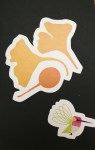
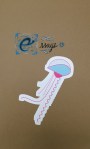
I find your images convey a sense of motion and life. There is, within these minimalistic drawings, breath that comes from, what appears to me, to be a release of inhibitions. Your drawings allow the birds to fly, the fish to swim, the plants to sway. Is expressing yourself through art a new avenue of creativity for you? What motivated you to illustrate your glossary?
Isaac: I’m glad to hear that you enjoyed the artwork! After completing the manuscript of Utter, Earth, I felt the text would benefit from a complementary visual element. Something spare and stripped down to balance off the density of the essays. It was then I came across the work of Buffalo-based designer and artist Julian Montague. He was offering an online design course on minimal graphic illustration, and was particularly interested in the relationship between image and text on the page. There was also more than a trace of whimsy behind his mid-century-modern styled projects, which included gallery posters of non-existent exhibitions and a field guide on stray shopping carts. Naturally I was sold and enrolled.
The resulting art came about a lot through play, much like with text really, but just with a different set of tools. Long before writing about the natural world, I connected with it through drawing. There was always something fascinating about how lines on the page can suddenly erupt into a creature, staring back. I’ve long been a fan of the work of Ohio-based artist Charley Harper, whose style captured flora and fauna in what he coined “minimal realism.” A few curves, a restrained palette, some simple shapes, and there it is, a revelation, revealing the geometry and order at the heart of the natural world. I was inspired by that artistic practice and philosophy and wanted to try working towards it.
Since then, the “minimal animal” project has taken on a life of its own. I didn’t expect to draw every creature mentioned in Utter, Earth, but I did pick some from each essay to turn initially into posters, and then later on standalone illustrations; I think there are almost 200 at last count! It’s been a fun journey. Pairing each design with short texts, sometimes taken from the glossary, sometimes written on a whim, seemed to offer a new way to connect with the subject and a new way to tell their stories. As you say, this is all in an attempt to allow the birds to fly, the fish to swim, the plants to sway, to capture and honour their mannerisms, their grace, or whatever label one can attach to that animate quality. After all, this is what we do as humans and artists, to abstract the real into signs and symbols of meaning. But I hope the vitality remains. That some essence is preserved.
BH: Before signing off, please share where you are living and what you are doing in the world.
Isaac: It’s been a privilege and a joy to be in conversation with you; I can’t believe it’s already been one year since Utter, Earth’s publication! As for what’s on the horizon, my partner Michaela Vieser and I are gearing up for the launch of our jointly-written book titled The Sound Atlas: A Guide to Strange Sounds Across Landscape and Imagination, set to come out in English this fall. It’s inspired in tone by Judith Schalansky’s Atlas of Remote Islands: Fifty Islands I Have Never Set Foot On and Never Will, and is a collection of essayistic vignettes featuring the stories of unusual sounds around the world and beyond. Naturally, there will be a lot of creatures contained within, from noisy fish and snapping shrimp to echolocating bats and singing cicadas.
We’re also in the research phase for another collection, this time revolving around the deep sea, tentatively titled The Atlas of Deep Sea Features: Stories and Soundings from the Depths. Michaela and I have had the good fortune to meet and learn from marine scientists and educators over the past few years, and given the plight of the oceans and the concerns around deep-sea mining, we thought we would embark on a project to try to raise the awareness and appreciation of these little-known places.
When I need a break from writing, I continue to dabble in illustration and graphic design. Currently I’m delving more into the world of aquatic creatures—fish, amphibians, marine mammals—anything I feel deserves to be recognized for their own agency beyond possessing value for us humans.
In short, there’s no lack of projects or of inspiration. It’s just a matter of realizing the visions and getting them out into the world!
[1] Holloway, M. (2011). In Amongst the Green Blades. The Lion and the Unicorn, 35, p. 132–145. https://www.researchgate.net/publication/236812913_In_Amongst_the_Green_Blades
Isaac Yuen is a first-generation Hong Kong-Canadian with a lifelong passion for the environment, Isaac Yuen pens short stories and personal essays exploring forms and themes around nature, culture, and identity. He holds a Bachelor’s in Environmental Science and a Master’s in Environmental Education and Communication.
Isaac is the co-author of the forthcoming collection, The Sound Atlas: A Guide to Strange Sounds across Landscapes and Imagination, along with Michaela Vieser and published by Reaktion Books. His debut solo nature essay collection, Utter, Earth: Advice on Living in a More-Than-Human World, was published with West Virginia University Press. The title piece with the same name, published in AGNI, was awarded a Pushcart Prize.
Isaac’s other creative works have been published at Gulf Coast, Newfound, Orion, Pleiades, Shenandoah, The Willowherb Review, Tin House online, and elsewhere. He was a 2019 Jan Michalski Foundation writer-in-residence in Switzerland, a 2023-2024 Fiction Meets Science fellow at the HWK Institute for Advanced Study in Northern Germany, and a 2024 Canadian artist-in-residence at the La Napoule Art Foundation in Southern France.
I can’t thank Isaac enough for the time and care he put into this interview. I hope you enjoyed reading it as much as I enjoyed preparing it!
Up next at TBH is an interview with Kristin Tenor.
Until next time,
Constance
 Constance Malloy
1 thought on “An Interview with Isaac Yuen”