
Welcome to The Burning Hearth! If I do say so myself, you’ve stopped by at a good time. I LOVE this interview with Tara Campbell, the author of the upcoming City of Dancing Gargoyles, due out this September from Santa Fe Writers Project (SFWP).
I was introduced to Tara through the Electric Sheep. Although we were on Zoom, Tara’s personality struck me at once: whimsical, witty, and intelligent. Knowing she was also a creative writing instructor (Check out her website for her various teaching venues.), she struck me as someone who would be that kind of instructor/mentor who changes the lives of the people she teaches. As the French saying goes, she has a je ne sais quoi about her. Given this (and her love of dinosaurs🦖 and Star Trek 🖖), I had to seek her out for an interview once ARCs were available of her book.
Publisher’s Weekly had this to say about City of Dancing Gargoyles.
“In this wild #postapocalyptic outing… Campbell’s unfettered imagination is sure to win readers over. Quirky and occasionally mystifying…offers plenty to entertain.” (Click here to read full review.)
I could spend my time further praising City of Dancing Gargoyles (it is worthy of much praise), but I’m simply too excited for you to read this interview. I promise, no spoilers are revealed. Oh, and BTW, it is available for pre-order. 😉
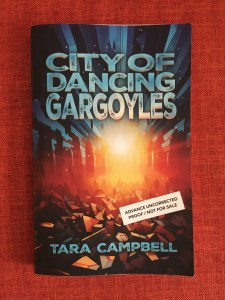
Interview with Tara Campbell
BH: City of Dancing Gargoyles opens with E and M, two sentient gargoyles in search of water. Immediately, we are in a world different from our own, yet we recognize the post-apocalyptic landscape as our own potential future one. There is something, however, about stone creatures being parched, desperately searching for water anywhere, even in the smallest of bugs and only during the coolest part of the day, that enhanced the desiccated scope of this reality. We all know climate change is going to impact water supply but upping the competition for it in this manner creates an entirely new challenge for any surviving humans. For me, this drives home the fact that none of us really knows what to expect if the globe bifurcates from climate change. As I’m writing this a heat dome is positioning itself over the southwest, and it is only early June. This might just be me, but I’m beginning to sense that a future event where parts of the world experience some form of a post-apocalyptic climate catastrophe is not only inevitable but not that far away. It makes me speculate if we, as a technologically advancing, resource-plundering species, have crossed a Rubicon where we can no longer imagine what the future consequences to our current actions will be. Do you ever wonder if we have tipped things so far out of balance that realignment can only be something wholly unfamiliar and new?
TARA: I think a lot of folks in our (relatively) functioning Western (quasi) democracy are still having a hard time imagining the reality of climate change. In a news report on the unprecedented flooding in Florida, for example, I heard a woman say something to the effect of “I’ve been through this before.” We’ve been conditioned to expect one single catastrophic event as a clear demarcation between now and then, when I think the reality will be a slow, inevitable slide toward a less livable future. That’s why I set the book in the next century, rather than the near future aftermath of one specific disaster.
So yes, we will have to realign. It may sound reactionary, but that’s part of the reason I chose to move to Washington State last summer. My main reason was to be closer to family, but moving to a more temperate climate was also a consideration. Extreme temperatures and weather events are already pushing people out of their homes in many places around the world, so it made sense to have that happen to characters in my novel as well. We’ll adapt as much as possible, partly because we have to, but also to distract ourselves from the hard truth that we should have taken action to stop it sooner.
If all of that sounds like a downer: yes, it is, but the book isn’t. I have a hard time with relentlessly dark dystopia, so I have to look at it slant, with a bit of humor, and with a glimmer of hope even in the chaos.
BH: As I was reading your book, I was continually filled with the sense that you had fun writing it. I perceived a deep affection permeating the pages for these characters and their stories. It didn’t seem to me that I was reading imaginary characters created in your mind, but rather real characters you knew. Like you had just returned from a walk with E and M yourself. That is no small feat. What brought these characters and their stories to life for you?
TARA: Despite the darkness of my first answer, yes, I had fun writing this book! It started with the worldbuilding, which is unusual for me. Inspired by novelist Michael Moorcock, I created a writing prompt for myself in which I made a list of nouns and verbs that fascinated me, then I chose one word from each category at random and figured out how both things fit together. Making stories out of these unusual juxtapositions was like solving a daily puzzle, and I’m a fan of puzzles. Then one puzzle led to the next when I gave myself the challenge of fitting all these stories together into a single world.
E and M began as the prompt “digging” and “gargoyles,” and they became main characters because their narrative didn’t resolve into a discrete short story. They needed more time to develop. We authors plant little bits of ourselves into all of our characters: Dolores got my curiosity (and my mother’s name), Rose got my stubbornness (and my mother’s middle name), Meena got the combination of curiosity and stubbornness we call “tenacity,” M got my skepticism about humanity, and E got my hope that maybe, just maybe, not all people are completely awful.
E and M also got aspects of my relationships. My husband is visually impaired, like M, so when we share a meal, I’m the one who splits it like E does in the first chapter. And in (many!) other ways, my husband protects and carries me, like M does for E. We each bring our strengths and do things for one another, and those dynamics are reflected in how E and M work together and value each other, even when they have different ideas about the best way to do things.
E’s friendship with Dolores reminds me of someone I used to work with in Austria. From the outside we probably seemed like improbable buddies, but somehow we clicked, traveling and laughing and just being silly together. He’s originally from Germany and I’m originally from Alaska, and maybe there was an aspect of journeying through another new environment together that found its way into the vibe between E and Dolores. This is making me want to call him on our birthday (yes, we have the same birthday!).
BH: I read in your acknowledgements that Robert Llewellyn’s photography in Darlene Trew Crist’s book American Gargoyles: Sprits in Stone served as a visual inspiration. Did you turn to Crist’s book after deciding to write about gargoyles or did her book lead you to the idea? What was the inspiration behind the telling?
TARA: I happened upon that book long before I started writing about gargoyles, probably after a tour of the National Cathedral. Gargoyles itch the same part of my brain that’s fascinated with dinosaurs—the weirder and scarier and toothier they are, the better! I used two of Llewellyn’s photos as references for a printmaking class I was in a couple of decades ago, and those are the two I had in mind while writing E and M (though the serpentine E deviated a little more from the original, which was an oddly bug-eyed and elongated horse).
BH: I loved the field notes! Please speak to the craft of using such a device to move narratives along. It seemed a terrific way to avoid information dumps. (And aren’t we all looking for those?)
TARA: The convention of field notes in the book spread from the story “In the City of Failing Knives,” a hermit crab in the form of a scientific report. As I wove the novel together, some stories became characters (digging gargoyles), some became settings (praying devils), and some stories morphed into reports emailed by citizen scientists to their boss Manfred at the Citizens’ Alchemical Realities Exchange (CARE). I marked up a Google map with all the cities in the book so I could keep track of who went where and how long it would take—again, puzzles! While I was trying to decide which reports would come from where, it occurred to me that a number of them skewed dark. This is when I hit upon the narrative of Joseph gravitating toward the twisted, messed-up places while Meena tried to stabilize things by steering them toward the light.
BH: Who was the first author you encountered who made you say, “I want to write like that?”
TARA: Oh gosh, my all-time GOAT is Margaret Atwood. Of course The Handmaid’s Tale and The Testaments get all the attention, and rightly so, but I was mesmerized by her MaddAddam books. The wry confidence with which she writes, bridging the speculative and literary worlds, and prognosticating everything we’ll do in the future based on all the harrowing, idiotic things we’ve done in the past—to carry all this off with such fluidity is the dream.
BH: If I’m not mistaken, you, like myself, are a Trek fan? If true, I’m curious. Favorite iteration? Favorite episode? Favorite captain? And, of course, a brief explanation of why for each.
TARA: Oh, it’s always the original for me. I’ve tried watching other iterations, but nothing quite captures the technicolor campiness of the original. That said, I loved the inventiveness of the J. J. Abrams/Justin Lin reboots (2009, 2013, 2016), the boldness with which they remixed original relationships and just said “deal with it.” There was a joy and verve to it that I’ll bet was like the vibe that hit audiences with the original.
BH: In closing, is there anything on the horizon you would like to share?
TARA: Heh, I wish I worked like that, having projects in the hopper and publications lined up. I’m in a new phase of life at the moment, having moved from DC to Seattle last summer and finding my footing here. I’m kind of working on a sequel, but pretending I’m not, because that’s never really been how my brain works. I didn’t start my first book, TreeVolution, thinking I was working on a novel. I was just writing through some “what-ifs” and other questions I had about trees. The four collections that followed weren’t planned as collections; they were the result of resonances I noticed in individual stories and poems I’d been writing. The gargoyle book didn’t start as a novel either; it was a fractured world coming together into a world as fractured as our own. I guess chaos is the only way I can create a book, so you know as much as I do about what’s next!
Tara Campbell is a writer, teacher, Kimbilio Fellow, and fiction co-editor at Barrelhouse Magazine. She teaches flash fiction and speculative fiction, and is the author of a novel, two hybrid collections of poetry and prose, and two short story collections. Her sixth book, City of Dancing Gargoyles, is forthcoming from Santa Fe Writers Project (SFWP) in September 2024. Find out more at www.taracampbell.com
Thank you for spending time with Tara and me. If you liked this interview, please share wherever you share.
Upcoming at The Burning Hearth:
Shze-Hui Tjoa discussing her resent book The Story Game (Tin House, May 2024).
Kylie Mirmohamadi discussing her upcoming book Diving, Falling (Scribe, September 2024).
Andrew Porter discussing his book, The Disappeared (Knoff, April 2023).
Sending you all peace and joy,
Constance
 Constance Malloy