
Welcome to The Burning Hearth and the spring rotation of “Circling Saturn with David Naimon.” With this rotation, I end my yearlong journey with my favorite interviewer/ee around my favorite planet. It has been a deep, delightful, whimsical, enlightening journey that I’m sad to see come to an end.
It’s given me joy to provide David this platform to speak (at length) on subjects and ideas that he might not otherwise do. (Okay, would not do. I don’t see the idea of relocating to Methone just popping into his head one day.) Likewise, as someone who is always transformed by David’s interviews, I hope those who have read of our discussions have been transformed as well. When you are in the presence of someone as inquisitive, insightful, knowledgeable, and generous as David, you become more of those things yourself. I am forever grateful to him for gifting those qualities to me throughout this journey.
It’s also been my delight to invite four guest questioners to join us. Kylie Mirmomahadi, Veronika Fuchs, Anthony Garret, and for our final rotation, Maura Finkelstein. Their respect for David is evident in their thoughtful questions; his respect for them is evident in his caring, generous responses.
It’s all been one great big feel good journey, and I’m so happy that you, reader, have joined us too! Thank you!
When I decided to ask Maura to be this rotation’s guest questioner, I thought it might be fun to co-author a question with her. She agreed and so the task was set before me to initiate this collective questioning of David. Having a general idea of what I wanted the content of the question to be, I sent her some random thoughts, my mental popcorn, wondering if she would add salt and butter or if my thoughts would fall so flat that no amount of salt or butter could offer hope.
Later that evening, she sent me an email. She had attached her musings on my mental popcorn. Let me just say this, as a trained performer, I know when it’s time to step back and grant a fellow performer a solo. Amazed that my random thoughts had led Maura to asking David the very question I was hoping to arrive at, I stepped back and offered Maura center stage.
Ladies and Gentlemen, for this last rotation of “Circling Saturn with David Naimon,” I present to you our guest questioner, Maura Finkelstein and the inimitable, David Naimon. Popcorn and beverages are allowed in the house. Enjoy!
Circling Saturn with David Naimon
Click on name to open section.
Maura’s Question
Dear David,
What a joy, to have this opportunity to ask you (asker of magical questions) a question myself! I’m so grateful to enter into this space of wonder and imagination that Constance has built for us.
Because I’m trained as an anthropologist, I spend a majority of my work life thinking about questions: how do I ask the people I interview questions that will invite them into the realm of storytelling we both want to pursue? How (to draw on Walter Benjamin) do I ask questions in search of a story, not just one that extracts information? So much questioning is undertaken in the service of extraction, an imperial, colonial form of conquest. Stories are different. They are relational, vulnerable, world-making.
Questions are also world-making, they can both expand a world and contrast a world. They can open up possibilities and they can foreclose those same possibilities. I spend a lot of time, in my capacity as a college professor, helping my students change their relationship to questions. I’ve found that many of them are scared of questions, scared of the shadows of their curiosity – the admittance that they don’t know something. You and I have talked before about how curiosity felt different before the internet, before social media. Before the possibility that we could find the answers behind a question if only we looked hard enough. This eliminates the sociality of questions, the way that question-asking is not just world making, but also relational. To fear curiosity because it’s an admittance of not knowing not only leaves us in the dark, it limits the possibility of being in relationship with other people’s ideas, knowledge, thoughts. Asking questions is a very vulnerable place to operate from, but it’s also crucial to our survival – connection through curiosity, an investment in the other, whether that “other” be friend, lover, kin, or stranger.
This leads me to the threshold of my question, which is about your questions. On Between the Covers, your questions become the blueprints of potential worlds, which you invite your guests into as an act of collaboration and co-creation. There are always themes, engagement with the guest’s recent book, old writing. But there’s also a scrambling of these things, a rearrangement of objects in order to create something new in the way you and a guest can engage these forms, perhaps a rearrangement of furniture in order to encounter an old space as brand new. This is a vulnerable work of creation – it relies on the willingness of the guest-as-other to walk into this blueprinted world and think with you through curiosity. And whenever that is taken up with generosity, literal magic is made. Worlds are built.
So now my actual question – there’s clearly so much research behind your questions – reading the writing of the guest, as well as watching, listening and reading their interviews, diving into themes by expansively reading beyond the guest’s own work for pearls that will enrich the conversation. But once that work is done, there is the task of the blueprint – building the questions, sketching out the worlds you will invite the guest into, where you can both think in this space of curiosity and vulnerability. How do you take on this task? How do you understand it as an exercise not of expansion or contraction (and therefore, not about power) but instead, world building, meandering but intentionally so, rooted on the ground (through the object of the writing) but also spiraling through space (in being tied to the realm of imagination, both tethered to and flying beyond the work)? An invitation.
With love, gratitude, and admiration, Maura
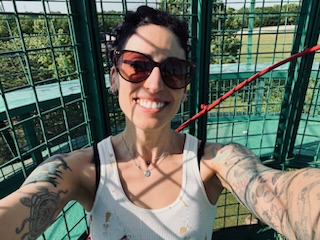
Maura Finkelstein is a writer, ethnographer, and Associate Professor of Anthropology. She is the author of The Archive of Loss: Lively Ruination in Mill Land Mumbai, published by Duke University Press in 2019. In addition to academic publications, her writing has appeared in Post45, Electric Literature, Allegra Lab, Red Pepper Magazine, and the Scottish Left Review.
David’s Answer
It is such a welcome surprise to end my year of “Circling Saturn” with a question from you, Maura. The first of these four rounds with Constance stands out as one of the most remarkable exchanges for me, insofar as Constance really attended to me and my writing in a way that I both had never experienced before and that echoed the experience I always hope for when interviewing others. To experience it from the other side was a gift I’ll never forget. Likewise, I couldn’t be happier to end this year, to close the circle, with a question from you because the question you have asked, a question about questions, is the central never-answered question I keep asking myself.
I’m probably the last person who can say this for sure, but I think the length and style of my questions is probably the most nonnormative thing about the show, one of the aspects that most sets it apart and defines it. One that, because of this, is a frequent thing mentioned by both those who love the show and those who don’t, as a reason for their feelings. When I polled supporters about whether I should shorten the preamble and intro (which most people didn’t want me to do), one general sentiment was, whatever you do with these, don’t touch the questions. And yet when I get negative reviews or hate mail it is also always because of the questions. This is the charged element of the show, and something I continually myself question.
One more thought, in my maximalist preamble, before talking about the questions more directly, a thought specifically for those people reading this who don’t know my show: My questions typically run three to five minutes in length, which is really long. But the guests are then given uninterrupted time to respond and usually their answers are at least as long, if not considerably longer. I think Bhanu Kapil holds the record of a twenty-two minute answer, and Diana Khoi Nguyen recently had an eighteen minute one. I always feel a certain thrill when this happens, even as I can also recall many fantastic conversation where all the answers are the same length as my questions too.
So my first, perhaps provocative thought, is that my questions might not be questions at all. And my second provocation is that they aren’t always, or entirely, addressed to the guest even if they seem to be. I’d like to start with unpacking this second aspect:
Ideally, I would like the questions themselves, even if the guest were not to speak at all, to provide a step-by-step portrait of the writer in question. That the listener who has no foreknowledge of the writer would be incrementally brought up to speed about the questions that animate their work, the writers that they themselves are engaged with, and more. And likewise, I would like the questions to create a line of inquiry, demonstrating my own engagement with the work and the meaning that I have taken away from my encounter with it. In this sense the “questions” are addressed to the listener, even when they end with a final short question to the guest.
There is another way the “questions” are sometimes addressed to the audience. There are many things that one can’t presume a listener will know (of history, politics, anthropology, philosophy, science etc.) that might be a major underpinning of someone’s art but, at the same time, not what the work is “about.” For example when I talked to Myriam Chancy about her novel set after the 2010 Haitian earthquake, to truly understand Haiti’s relationship to Western powers and outside aid, you have to engage with the unprecedented way slaveholding countries conspired to make the first Black republic a failure, as well as the century-long indemnity France forced upon Haiti (estimated to be $20 billion dollars, or with interest $120 billion dollars) for “stolen property” (for enslaved Haitians freeing themselves) and the ways this prevented any domestic investment in infrastructure. This isn’t, in an immediate sense, what Chancy’s book is about. And rather than putting the burden on her to spend the time, time she’d surely like to use talking about her book, educating everyone, I try to seed my questions with some of the historical background, one question at a time. I suspect this would be a challenge in any country, all that we generally don’t know, but it is particularly acute, I think, in the seat of empire. Where we like to export our own culture and then look at and admire ourselves everywhere. I don’t exempt myself from this ignorance. Quite the contrary. I feel an attraction to conversations where I sense both an interest in myself, and a complete lack of knowledge about some aspect of it. There is a joy in trying to gain some sort of bare minimum competence in a subject (e.g. Aboriginal songlines, the transSaharan slave trade, the Jewish Labor Bund) in order to be able to have a conversation with someone who knows far more than me.
I think this is a good place from which to answer how these questions are or aren’t questions, as well as to speak to your question of power in the conversation, and the risks of being extractive. Again, I am probably the last person who can judge this, but at least in spirit, what I’m trying to do is have the conversation within the universe of the guests concerns and animating questions. For me to prepare in such a way as to get oriented to the terms of their world, to enter their universe, and to speak to them within those terms. To construct questions that involve citing their own words back to them, citing the work of others I might place in relation to their work, or that they themselves explicitly engage with etc. Sometimes I simply create this field of thoughts and there literally is not a question at the end other than “does this spark anything in you?” There are many great conversations where most of the responses aren’t really answering the question. They are oblique to the question but nevertheless super interesting. I’m fine with that.
One thing I hope, is that the part of the question that is half-oriented to the audience demonstrates some depth of knowledge to the guest, so that they can start deeper, so that they can say things differently too.The poet Simon Shieh said the conversations were less an interview than a co-created essay. I think the reality of it is indeed closer to Simon’s view than that of an interview for sure.
I don’t put any of this forward as a correct or even good way to do things. I’m constantly questioning my questions. I feel like they come with upsides and liabilities, like any choice away from expectations. And when people come to the show, used to the more typical interview style, who knows how any one person is going to feel about it. That said, I wouldn’t still be doing it this way if this style hadn’t found its community it worked for. A style that has evolved over time, through the call and response between myself and guests, and between the conversations and those listening to them. In the end, I knew that I wanted the show to exist in a different way, where the act of learning could be enacted in an inviting way, as if we are learning it together, by bringing the material from my own preparation into play in this way.
I was very moved by your framing of all of this in your own work Maura, as both a writer, a teacher and an anthropologist. Your interest, within your own work, and with your students around how to not reproduce what is wrong with the world, but to make new worlds, to world-build, is one I share. There was one small aspect of your intro, however, where I found myself with the opposite experience from yours, when you say: “How (to draw on Walter Benjamin) do I ask questions in search of a story, not just one that extracts information? So much questioning is undertaken in the service of extraction, an imperial, colonial form of conquest. Stories are different. They are relational, vulnerable, world-making.” For me, I would actually say the opposite, that so many stories are undertaken in the service of extraction and conquest, whereas questions are different—relational, vulnerable and world-making. Perhaps as a way to end, I can spend a moment about why I am wary of stories.
There are many ways the encounters with writers on the show have, step by step, changed me. One of them is in regard to stories. For the first several years, when I was still getting my legs under me as a literary interviewer, I only interviewed fiction writers. And for several years after that only prose writers. This was simply because it was what I knew and felt comfortable with. I didn’t know if I could talk about poetry (let alone hybrid and indeterminate work) and I was far less familiar with it. I was even a little intimidated by it (in my ignorance of it). But thirteen years later I sit at the far opposite end of the spectrum, something I could never have anticipated. The guests I most look forward to talking to now are poets, and prose writers who have a poetics and people in any genre working against the forms they are operating within. I still love to read a well-written formally normative story, but I’m more interested in prose writers working against narrative in some way, whose stories are porous to and troubled by counternarratives. And part of that is because of, returning to questions of power, just how powerful stories are and how they are often used by the powerful to maintain and sustain structures of power. I think of Edward Said saying “the power to narrate, or to block other narratives from forming and emerging, is very important to culture and imperialism, and constitutes one of the main connections between them.”
And thinking of Michel-Rolph Trouillot saying that “any historical narrative is a bundle of silences,” I think the power of narrative is its ability to hide that bundle, to seduce us with a smooth forward motion that sweeps us away from the violences it creates. I also think about my conversation with Padraig O’Tuama where in his reconciliation work between Protestants and Catholics in Northern Ireland, he says (roughly, from my memory) you can’t begin with each side telling their own story, for when they do, it is either a list of grievances or an assertion of one’s goodness, and usually a mixture of both. Instead, he has them encounter each other through a shared third thing, the Book of Ruth, that comes from both of their traditions, is a book most aren’t very familiar with (a good thing), and is about mutual aid and risk across borders between people who hate each other (and a book that includes no divine intervention, so a book an atheist is equally welcome within). That through using this third shared space, it perhaps prevents one’s own story from shoring up the self, and instead creates the possibility of a crossing over, of finding openings within one’s own story that one couldn’t see before. In a way it works against both stories without canceling either.
This question of the danger of story, I think is both a macro phenomenon and one that goes all the way down to the level of the syntax of a sentence. With the former, I think of adrienne maree brown’s notion of the imagination battle, that if we aren’t actively trying to imagine the world we want to live in we will ultimately be living within the stories of others. And thinking of Joyelle McSweeney’s thoughts on the English sentence in particular, she says: “The English sentence only moves forward. Run it backward and all meaning falls apart. Compared with other languages I’ve encountered as a publisher of translation, English can only tolerate the merest fingernail’s width of temporal delay, of logical uncertainty, the time it takes to glance from one noun or verb to the next in the line, before our sense of the world falls apart.” This makes me think of Rosmarie Waldrop, who works against the forward motion of time in the sentence in her prose poetry, something she calls “gardening the gap.”
I’m interested in the gaps, in temporal delay, logical uncertainty, in contradiction and in nuance, all of which I think a question can conjure better than a story. But my story about stories is itself a story and I want to end with a countervailing notion of them that I believe is also true. I correspond with an indigenous psychotherapist who lives in Australia, whose work is both land-based, cross-cultural and relational, and anti-colonial. She was talking to me about some neurobiological studies being conducted on people, indigenous and non-indigenous, when they listen to Aboriginal stories. Many people try to escape the tyranny of the executive function aspect of their brains, the “getting things done” forward movement part of our lives that interfaces so well with the demands of an individualistic capitalist extractive culture, by various mindfulness practices. And, in her framing of things, these practices are ways to escape that part of the brain. In contrast, when one hears Aboriginal stories, it actually calms this part of the brain and activates another region of the brain associated with wakeful rest. To hear stories of deep time, of belonging, of interconnectedness, to be in the presence of these types of stories, causes these other anxious stories to recede. One doesn’t have to find a way out in the presence of these stories. These stories are the way in.
David Naimon hosts the radio broadcast and podcast Between the Covers and is coauthor of Ursula K. Le Guin: Conversations on Writing (Tin House Books, 2018). His writing has been published in Tin House, AGNI, Boulevard, Virginia Quarterly Review, and elsewhere, was reprinted in the 2019 Pushcart Prize anthology and the Best Small Fictions 2015, and was cited in Best American Essays and Best American Travel Writing.
As always, thank you for stopping by The Burning Hearth. I hope you’ve enjoyed this question on questions. Click on the links below to read the previous “Circling Saturn with David Naimon” rotations.
I have big news! My hybrid novelette Born of Water is due out next month as part of the Afternoon Shorts series at ELJ-Editions.
Born of Water begins with the narrator, her husband, and their infant daughter hanging from a cliff. Their perilous climb, representing the difficulties involved in breaking the dynamics of familial dysfunction, leads to an existential exploration of the birth of fictional characters and how they, like children by their parents, are shaped by the author’s experiences. At its core, this hybrid novelette delves into the questions and the consequences of changing climates, both internal and external. Set by the banks of the Menomonee River, and along the shores of Lake Michigan and Green Bay, Born of Water concludes with the speculative fiction story of Mari, a writer of obituaries for dying bodies of water, struggling to identify her true nature and to heal her own climate crisis.
Stop by Diane Gottlieb’s blog next week to read my answers to her incredible interview questions and for the Born of Water cover reveal.
Lastly, next month is The Burning Hearth’s first “Voices of the Summer Solstice.” Be sure to stop by and read these stories inspired by the theme “What Blooms.”
Until then, stay safe and take some time to enjoy the flowers and the birds.
Constance
“Circling Saturn with David Naimon” Winter 2023, with Anthony Garret
“Circling Saturn with David Naimon” Fall 2023, with Veronika Fuchs
“Circling Saturn with David Naimon” Spring 2023, with Kylie Mirmomahadi
 Constance Malloy
1 thought on “Circling Saturn with David Naimon Spring 2024”