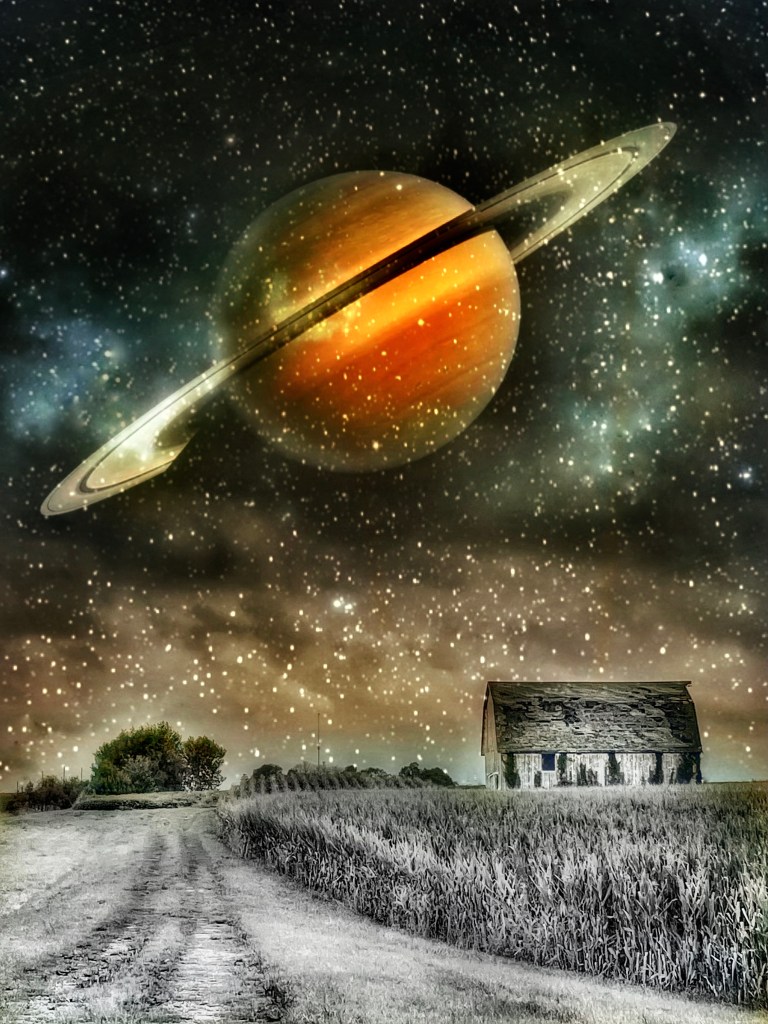
Winter by Audra Kerr Brown
Welcome to The Burning Hearth and the winter rotation of “Circling Saturn with David Naimon.”
I’m beginning this rotation with a bit of backstory.
Upon seeing a post in January of 2022, on then Twitter, for a “Crafting with Ursula” podcast series at Tin House by a guy I had never heard of named David Naimon, I dropped everything I was doing (It was Ursula after all.), to listen to his interview with Becky Chambers. David proved, in my estimation, to be a deft interviewer. I felt like I was listening to someone with interviewing chops akin to Bill Moyers. (I still miss Moyer’s Now.) In listening to David’s interviews, it became unmistakable that he was deeply interested in his subject matter and that he was a profoundly interesting person.
Immediately, I wanted to be in conversation with this person. Believing that would never happen, I went about my daily life, until his interview with Isaac Yuen. That interview hit me like a gravitational wave that reawakened and agitated thoughts and ideas that had long been dormant. Because I am me, I just had to let David know; so, I sent him a DM. I thanked him for such an inspiring interview and briefly shared its impact on me. Much to my surprise, he responded. Two years later, here we are.
After a 3-part interview with him in August of 2022, he agreed to this 4-part series. In our first rotation, Spring 2023, we discussed his essay “May Your Memory Be a Blessing” along with AI, and welcomed guest questioner Kylie Mirmohamadi (Who, by the way, has the best listing of craft books I’ve ever seen. Click here to view.). I invited the lovely, kind-hearted Veronika Fuchs to join in our conversation after I sent David packing to Saturn’s moon Methone in our Fall 2023 rotation. And now, for our Winter 2024 rotation, I pose two thought experiments to him. I can’t wait for you to read his responses. They include chimps and Woody Allen. Chimps and Woody Allen? Yes, chimps and Woody Allen. Anthony Garret’s guest question follows. Enjoy!
Circling Saturn with David Naimon: Winter 2024
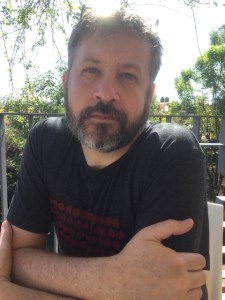
David Naimon
Burning Hearth: Like so many people, I’m captivated by trees. They are elegant, like a silver-white birch; spooky, like a gnarled willow; majestic, like a many-branched oak; towering, like the ancient Sequoia. As a child, I begged to have a tree house built in the maple tree that dominated our backyard. My pleas went unanswered but I’ve always dreamed of living in a tree.
This past year, you’ve had two Tin House live conversations with authors regarding trees. Richard Powers on The Overstory and Katie Holton on The Language of Trees. I recommend both the books and the interviews to readers if they haven’t already read or listened.
(Click on the author’s name for their website or on their book title for their Between the Covers interview.)
Thinking about trees and your interviews made me think about Italo Calvino’s The Baron in the Trees, which then, somehow, led me to thinking about Cloud City in Star Wars. (Don’t ask.) Loving space as I do, I wondered, if given the choice, would I rather live in a tree or in the clouds. So, you guessed it. I’m going to ask you. Would you rather live in a tree or in the clouds?
David: First, I have to wonder, Constance, fresh off of sending me to one of Saturn’s moons in our last round of questions, if this is a theme, sending me away again—up into the clouds or up into the trees. It makes me realize I like home. And I like the ground! If I think of a cloud, and a cloud’s ecosystem, an ecosystem primarily made up of bacteria and fungal spores, it seems both supremely lonely, and well, high up in the sky. Would living high up in a tree be less lonely? Less above and away? Ultimately, I’m not sure. But I want to give these choices, my only choices, a chance. I think of when I was eighteen years old, fresh off a disastrous stint volunteering at a rural hospital on the border of Kenya and Uganda, suddenly feeling like my bold plans for life had been fundamentally defeated, and that my life couldn’t possibly make the slightest difference in the world, in the ledger of pain and happiness. I traveled alone for several months, doing a wide circle around Lake Victoria, before returning home. I remember sleeping on a sand bar near the tip of Lake Tanganyika, drinking a fermented banana drink, that us itinerant outside sleepers called “banana beer,” waiting to be able to hitch a ride on the only cargo boat the next morning heading down to Gombe National Park. A park, at least then, only accessible by boat. And the park where Jane Goodall studied chimpanzees. Goodall wasn’t there when I arrived. But if you made it all this way, the scientists sort of guaranteed you’d get to see chimps. An easy promise, because those habituated to humans would usually show up every day to say hello, and get a snack. But no chimps showed up, which was a lucky thing. I was offered, as a form of compensation for their absence, the chance to go out into the forest before dawn with the scientists the following morning and to camp out under the chimp nests, to watch them wake up and start their days. To follow them as they foraged. I had no idea chimps built nests in trees. But to watch them in the pre-dawn light, stretch their arms above the brim of their nests, the first thing you’d see, chimp arms stretching, was really so unforgettably human. Thinking of this, perhaps I could live in a tree if someone could teach me to build a nest, and some of my favorite people were coming to nest with me.
I admit that my first response to this tree vs. cloud question was to finesse my way out of choosing. Perhaps I could live in a cloud forest, I posed to myself. Right before visiting Gombe, in my broad circumambulation of the lake, I had been in Rwanda to visit the mountain gorillas. The visiting of the chimps and gorillas were the highlights of my time in East Africa. I don’t think it was because they were the most human-like nonhumans I encountered, but rather because both of these encounters were while standing on the ground (vs. say, being in a jeep on safari), standing on shared ground with nothing separating me from these others. I don’t know what it is like there now, or in Gombe now. Perhaps there are monorails and small yachts that take you to each respectively. I hope not. But 35 years ago in Rwanda you hired two people (easily hired on a backpacker’s budget)—a machete wielder to hack an improvised trail up the side of the cloud-forest-covered volcano and a rifleman who served as one’s guide. The rifle in case we encountered poachers. It was a steep climb where we often had to pull ourselves forward and upward by the vines we were pushing up and through, vines with nettle-like spines. So we climbed with two socks on each hand. And then at some point, only obvious to the rifle-armed guide himself, he asked us to be still and quiet and started grunting. Before long several gorilla kids had joined us, gorillas within less than an arms-length, a good 150 pounds each, dangling from branches, pounding their chests playfully, like miniature King Kongs, while their 700-pound silver back father looked on from afar. Here we all were, in the clouds, in the trees, together, no trails, no human structures, just us and our cousins hanging out on the steep side of a volcano, like cousins do.
But look, I don’t want to live on a moon or in a tree or in a cloud. If I’m honest, I want to invert the terms of this question. I think of the tree in Jewish mysticism, the Tree of Life whose roots are in heaven, in the clouds, and whose branches are on earth. Those are the branches I want to be among. Or I think of a photo of Layli Long Soldier and her daughter on Facebook, where they have fashioned hats out of large tumbleweeds. Where it looks like a tree is growing out from the crowns of their heads. That.
Burning Hearth: Lately, I have been faced with thinking about more things regarding this life than I would have otherwise chosen to do. Especially, in such a compressed amount of time. It has inevitably left me wondering how different things could have been under different circumstances.
Upon reflection, do you feel your lived experiences would have been enhanced by certain things being omitted or by certain things being present that weren’t?
David: I do think there is a design flaw within life. Like, why don’t we come into our full self-awareness at the same time as we arrive at our most robust physical capacity and well-being? Why are these two trajectories at odds? And, as we hit our stride, with what means the most to us, why is that often also the time when we are most weighed down with responsibility (and physical limitation) vs. the time we most have to play? I do think that the time I was most “free,” most unburdened, was also the time I was most clueless. And imagining I could be in that time of experimentation and freedom, but doing so having already achieved a significant degree of self-knowledge, that is compelling to imagine.
I hate to bring up Woody Allen here. The ick factor of him in the world seeps backwards into his earlier films, his quasi-autofictional works that often unavoidably remind you of everything you now know of him in the world. And yet, I want to rescue some of these films from him. One of the greatest reading joys in recent memory is the Paris Review roundtable, assembled by Sheila Heti, called “We Need the Eggs: On Annie Hall, Love, and Delusion” that does just that for one of the great American films. A meditation on one of the movie’s central joke-riddles, this conversation is erudite, hilarious, and hilariously erudite. I love it and love how it allows me to more fully embrace and celebrate this movie, not only the way I did for most of my life, but now in this comically, and yet deadly serious, Talmudic way, with this assembly of secular literary cinephile jester rabbis. (And as a complete random aside, to stay with joy one more moment, the other stand-out reading experience of recent uncontained joy was also thanks to Sheila Heti, her three-part, increasingly unhinged, encounter with various A.I. chatbots that begins with Hello World! Part One: Eliza. Not to be missed!)
I bring this all up as a maximalist preface and, perhaps foolhardy, attempt to rescue the following Woody Allen comic reflection on life’s design flaw, which to me contains some real truths in it:
“In my next life I want to live my life backwards. You start out dead and get that out of the way. Then you wake up in an old people’s home feeling better every day. You get kicked out for being too healthy, go collect your pension, and then when you start work, you get a gold watch and a party on your first day. You work for 40 years until you’re young enough to enjoy your retirement. You party, drink alcohol, and are generally promiscuous, then you are ready for high school. You then go to primary school, you become a kid, you play. You have no responsibilities, you become a baby until you are born. And then you spend your last 9 months floating in luxurious spa-like conditions with central heating and room service on tap, larger quarters every day and then Voila! You finish off as an orgasm”
Wouldn’t it be amazing to end, to die, from maximal overcapacity? To break beyond ourselves into death from a certain too-muchness? To flower in a bewildering kaleidoscope of colors as a last most memorable gesture? Plus, that wonderful line, that could only be written from within this other better world, “you become a baby until you are born.” Sign me up!
Anthony Garrett is someone I’ve come to know on X through our mutual likes and reposting of David’s Between the Covers interviews and his support of The Burning Hearth. Anthony seems to be introspective, kind and open, making him the perfect person to join us for our winter rotation. I know you will enjoy David’s response to Anthony’s tiny but mighty question.
Guest question by Anthony Garrett

Anthony Garret
Anthony: I have told you countless times, David, in public and private, the affect you have had on my reading life, my writing life, my daily life. Your influence has quite literally changed my life. This compliment has usually been shaped around the erudition and poetry of your podcast guests, but you—along with other interviewers, like our shared friend Rachel Zucker—have used the podcast as an art form, along with a number of other trends right now, to make literature more of something, despite its lonely appearances, it has always, at least in part, been: communal. At the same time, I am cautious of claiming more for books than they accomplish, thinking in particular of past Between the Covers guest Teju Cole’s 2013 New Yorker article “A Reader’s War,” especially in a moment when hegemonic forces commit genocide and ethnic cleansing in Palestine and Sudan and elsewhere, and yet many of the strongest voices in this moment are those of writers and poets, especially those from Palestine and the Palestinian diaspora. So, I won’t ask what can literature do? I won’t ask who you turn to, in books and in life, in moments like these and which books and authors show, if literature is capable of anything at all, what literature can do? I’ll ask a much shorter question, which you can choose to answer for yourself or generally, about this moment or any other: why read? Thank you, David.
David: Thank you, Anthony, for both these kindest of words and this impossible to answer question. Yes it is, as you say, at least in a technical sense, quite short, your question. Two words! And yet…
On the one hand, my own experience with reading tracks with James Baldwin when he says: “You think your pain and your heartbreak are unprecedented in the history of the world, but then you read. It was books that taught me that the things that tormented me most were the very things that connected me with all the people who were alive, who had ever been alive.” There were certain books, mainly before I was 25, that felt like they changed me forever. That my encounter with them became part of who I was in a fundamental way.
On the other hand, I don’t think reading necessarily makes you a better person. Not only could I imagine many other things producing the same effect that reading had for Baldwin—listening to the stories of others, or to fictional stories by the fire, travel, theatre/performance, political acts of solidarity—but also I suspect we can all think of plenty of people who fetishize books who are insufferable humans. I wouldn’t go as far as Schopenhauer but I recognize a truth in his writings on reading: “…the person who reads a great deal — that is to say, almost the whole day, and recreates himself by spending the intervals in thoughtless diversion, gradually loses the ability to think for himself; just as a man who is always riding at last forgets how to walk. Such, however, is the case with many men of learning: they have read themselves stupid. For to read in every spare moment, and to read constantly, is more paralyzing to the mind than constant manual work, which, at any rate, allows one to follow one’s own thoughts.”
And, in the spirit of Robert Burton, we can’t ignore the physical effects: “Students are commonly troubled with gouts, catarrhs, rheums, cachexia, bradiopepsia, bad eyes, stone and colic, crudities, oppilations, vertigo, winds, cramps, consumptions, and all such diseases as come by overmuch sitting; they are most part lean, dry, ill coloured, spend their fortunes, lose their wits, and many times their lives and all through immoderate pains, and extraordinary studies… How many poor scholars have lost their wits, or become dizards, neglecting all worldly affairs, and their own health, wealth, esse and benne esse, to gain knowledge? for which, after all their pains in the world’s esteem they are accounted ridiculous and silly fools, idiots, asses, and (as oft they are) rejected, contemned, derided, dotting, and mad… Go to Bedlam and ask.”
In the end, “why read?” becomes something I can’t answer for others. That if I answer it at all, it is only to answer why I read. To escape? To engage? To find comfort? To be challenged? To imagine another life? To experience another mind? To find myself in the stranger? To find myself strange?
As one of the “People of the Book” I am of two minds about the Jewish mystical notion that the world was spoken into being, that the world itself is made of letters. I could find this disturbing, that humans would drape their consciousness over the world and then call what they see the world instead. But what if the thing that most makes us human, the gift of language (and by extension story and poetry), what if the thing that is most us, isn’t us at all. What if our language isn’t ours? What if what we speak, and the worlds that speech creates, is itself something other than us? Something alive on its own terms? I think of the words of two fellow writers in my tribe.
First, Rikki Ducornet in her novel Brightfellow, the character here speaking about the letters on the page of a book:
“She says that when they collide into one another they are like animals that change shape before your eyes. They leave tracks across the page. They are round, soft, thorny; they have edges. The letters come together, she whispers right into his ear, in order to delight, to derange us. They come together, they hold hands, they caress, they bruise one another, they force the soul down deeper, they make us thirsty for unimaginable things, they shake their limbs and dance, the page is their stage, they make music, see: that h looks like a harp.”
And finally, Edmond Jabès:
“Writing a book means joining your voice to the virtual voice of the margins. It means listening to the letters swimming in the ink like twenty-six blind fish before they are born for our eyes, that is to say, before they die fixed in their last cry of love. Then I shall have said what I had to say and what every page already knew.”
David Naimon hosts the radio broadcast and podcast Between the Covers and is coauthor of Ursula K. Le Guin: Conversations on Writing (Tin House Books, 2018). His writing has been published in Tin House, AGNI, Boulevard, Virginia Quarterly Review, and elsewhere, was reprinted in the 2019 Pushcart Prize anthology and the Best Small Fictions 2015, and was cited in Best American Essays and Best American Travel Writing.
Anthony Garrett is a full-time parent and a novelist. He holds an MA in writing from Johns Hopkins University, where he received the Outstanding Student Award, and he is a Tin House Scholar. His novel in progress is titled NEITHER THEMSELVES NOR EACH OTHER. You can find him across social media @anthgarrett.
Many thanks to Anthony for such a wonderful question! It was great having him travel along with us to Saturn and back. The Burning Hearth wishes him much success with his novel in progress.
Thanks always to David for his generosity and care in his responses. We have one more rotation, which will post in late spring. I have invited the fabulous, dynamic, Maura Finkelstein to join us for our last fly around Saturn. She has agreed to co-author the final (nesting) question with me, so look out David.😉
To all my fellow travels, stay safe and warm!
Laugh when you can, cry when you should, and always be true to you!
Constance
 Constance Malloy
1 thought on “Circling Saturn with David Naimon: Winter 2024”