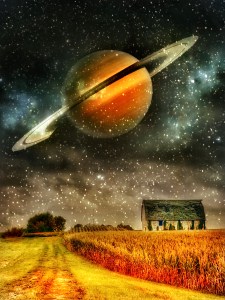
Autumn by Audra Kerr Brown
Welcome to The Burning Hearth and “Circling Saturn with David Naimon,” host of the literary podcast Between The Covers.
I began formulating my question for this rotation by contemplating various aspects of expansion and contraction, but I quickly found myself resisting my self-assigned task and decided to table those thoughts for a future rotation. The truth is, I wasn’t in the mood to think that hard or deeply about anything, given how heavy my life had been over the last 18 to 24 months.
Yet, I still had to provide David with a question.
As my mind relaxed, I began to think about David saying he picked people to interview he felt confident would engage in interesting, in-depth conversations. (As a listener of Between The Covers, I can say he succeeds in this endeavor in spades). This led me to wonder: If David was limited to being in conversation with only one author, who might that be? And this led me to the following whimsical approach to an oft-asked, speculative question, which David graciously responds to with equal doses of wit and intellect. Enjoy!
Circling Saturn with David Naimon: A Space-Tale
On a hot day, in late July 2023, David and I decided to take off from this burning, steaming, flooding planet, where sweet little blue birds get X’d, and head to Saturn to discuss our upcoming Fall rotation. After paying a small fortune for a custom space-innertube, which was enclosed in an oxygen bubble and fitted with mini deflector shields and a fridge, we began our trek around Saturn. As we free floated among the outer rings, David was on a roll. He was going on and on about his cat, who sounded adorable, but after a while, I had to change the subject.
Just as I asked him his thoughts on the sixth mass extinction event, a football-sized probe zoomed up to us and matched our orbit. A proboscis-like tube uncurled from an opening in the probe and attached itself to the wall of our bubble. All thoughts of cats and extinction events vanished.
“I am of the egg-shaped moon, Methone,” a voice stammered in English. Obviously, not the Methonian’s native tongue. “I come from a small civilization looking to diversify. I believe David Naimon is in this space structure. Am I correct?”
Flummoxed to the point of paralysis, neither of us answered.
“We have been listening to many of you Earth people talking,” the voice continued. “Much noise comes from your planet that is completely useless; and it seems, no one listens to one another. But it would appear many do listen to this David Naimon person and his talks with others about life Between the Covers. Someone in this small space craft sounds like him. We are eager to find him. We want to salvage something of your planet, while at the same time, reaching our goal of diversification. We want to bring David Naimon to our world.”
Wide-eyed, I looked at David. Clearly, if you are David, which David is, this was a tad bit frightening. We all remember the Twilight Zone episode “To Serve Man.” Not wanting to land on an alien menu, he wasn’t sure it was in his best interest to answer. But then, it dawned on him, as long as his wife and cat were allowed to join him, they would all avoid the sixth mass extinction event.
After a lovely visit to Methone, and their reassurance that his wife and cat could accompany him, David agreed to the terms of his relocation.
The terms were as follows:
1.) He must select one author, one artist, and one musician, living or dead (the Mehonians can travel to the past and spacetime-nap Earthlings), whom he wants to remain in conversation with. Caveat, none of their work can go with them; however, they will be allowed and encouraged to create new work.
2.) He must bring with him the collected works of one author, one artist, and one musician. Again, living or dead. Caveat, no repeats in his selections.
3.) He is to prepare a presentation to be shared with all of Methone as to why these are the people he selected for each category. Thus, allowing the Methonians to understand the significance of each of his choices.
With much effort on my part, the Methonians came to understand the significance of David’s relocation for his listeners, and the loss they would experience in his absence. Graciously, they agreed to share David’s presentation with Earth, which I received yesterday via space carrier worm.
Sadly, I was not allowed to stay on Methone, but I, along with my family, have been secured relocation before Hal refuses to open the pod bay door.
David Naimon’s Presentation to the Methonians
Dear Methonians,
I am grateful to you for rescuing my family from human folly and for your invaluable help in the interlunar negotiations that resulted in the safe settlement of Constance in the Herschel crater of your neighbor-moon, Mimas. Much like the improbably smooth and uniform surface of your egg-shaped home, your questions to me, at first glance, seemed straightforward. And yet, on further examination they are impossibly complex. These are not “desert island” questions at all, but actually the farthest thing from that familiar fantasy exercise. I will explain why below:
1)I am not coming alone. But with Lucie and Zora the Roan. If I were to pick the collected works of John Cougar Mellencamp, for instance, I would not only suffer Methone’s first divorce but Methone’s first homicide.
2)In inviting an artist to live here with us I have to consider living in a confined setting with this artist. In other words, I cannot simply consider how important their art is to me (or my human and feline family) but whether I could stand sharing space with them. Suddenly Dostoevsky’s antisemitism, paranoia and gambling addiction are put into play. Especially considering that your moon’s surface area is one-tenth that of the island of Grenada.
3)In my choices, I also need to consider the happiness of those I invite to join us. And, likewise, whether I myself would be happy with what they would want to read and listen to.
4)Finally, I also must consider you, my dear Methonians. And what pleasures or insights you will receive from my choices. Or, if your motives aren’t as noble as we hope, which artists you will exploit for nefarious purposes. What would translate well? What would be entirely lost to you? Should I lean into legibility or mystification? The Monster at the End of This Book or Jabberwocky? (and which would be which to you?)
Impossible as it is, I will take all of this into account. But instead of trying to please everyone (and thus please no one), each answer will attend to various and variable elements of our newfound home community.
QUESTION #1:
One author, one artist, and one musician, living or dead to cohabitate with on Methone
ARTIST: The Pufferfish
One advantage of inviting the pufferfish to create pufferfish mating art is that Methonians would need to build habitat for a pufferfish to live and thrive. Thus, in doing so, making the lunar surface of icy fluff more hospitable and interesting for other Earthlings. The other advantage is pufferfish mating art itself.
AUTHOR: Rabelais
The 16th century writer François Rabelais would provide a lot of skills. A novice of the Franciscan order he was, at the same time, an anticlerical humanist, one who read and reveled in works that were prohibited by the church, works written in Latin, Greek and Hebrew. And Rabelais was not just a clergyman but a doctor. And one of the first doctors to dissect a human body. And not just a doctor but a botanist. And not just a writer but a translator. And not just a writer-translator but a writer who engaged in incredible linguistic wordplay and was not afraid to offend. And as a bon vivant, with an incredible wit that delighted both his patients and his readers, he would be a great companion at the dinner table. And much as he tried to heal the schism between Catholics and Protestants, he much more successfully evoked in his fiction a world where there was no schism, no distinction, between the world of the mind and the world of the body. Where “high” flights of philosophical inquiry were inseparable from the “low” humor of the body. Where pooping and passing gas and giants contemplating what best to wipe their asses with (geese as it turns out) are not happening alongside philosophy but continuous with it.
As my anatomy teacher once said: we are all, each of us, when all is said and done, merely a glorified tube.
MUSICIAN: Björk
This new life is going to be difficult to make mesh. Who better to do so than Björk, with an aesthetics that embraces technology, but a technology that looks to nature for its forms and function, one that celebrates the nonhuman, that brings a diversity of musical influences into her work and which is defined by a singular voice. Who better to have as our new band leader, helping to harmonize Zora and the pufferfish, the Methonians and the humans, finding how we can all live together and make art together. Plus, given her omnivorous and insatiable mode of being, her and Rabelais are surely going to hit it off. And meals together will be full of surprise and laughter.
QUESTION #2:
The collected works of one author, one artist, and one musician.
AUTHOR: God(s)
The Collected Works of God (in the broadest sense of her) seems like a good way to go. From the Hebrew Bible to the Mahabharata, from witches notebooks to The Passion According to G.H. (surely itself a sacred text of sorts, no?), it seems like the ways humans have imagined the unknowable and unfathomable is a key to understanding us.
ARTIST:
Paul Valéry has a quote that I learned from reading Matthew Zapruder’s remarkable new book Story of a Poem. It goes: “A fine line of poetry is a fruit plucked from the tree. But which tree? This leads to the curious point of trying to make the tree whose fruit would be this fruit. Finally, then, it is the fruit of two trees. One hidden, unknowable, which produced the fruit. The other, the work in which the fruit takes a more or less necessary place.” From this quote Zapruder suggests more generally that we must identify what we love (the fruit) and build the world from which it could exist and thrive (the tree). My pufferfish mating art is suggested in this spirit. And so is the collected works of Charlie Chaplin. Not necessarily because of Chaplin in particular. Though it could very well be because of Chaplin. Certainly The Kid, The Circus, Modern Times, Limelight and so many others. But I want to believe I could choose any artist within film—Toshiro Mifune, Shah Rukh Khan, even a glorious moment in film—Arletty in The Children of the Paradise, Sidney Greenstreet in The Maltese Falcon, Jean Arthur in Talk of the Town, Jennifer Jones in Cluny Brown, Nina Hoss in Barbara, Murnau’s Faust, Barbara Loden’s Wanda— and the Methonians would then have to recreate the means to enjoy film on Methone. If for nothing else, for the tightrope monkey scene in The Circus.
MUSICIAN:
I figure that with Björk around we are going to make a lot of eclectic, strange and challenging music together as she builds a new catalog. Yes there will be her quiet duets with Rabelais (in the style of Neil Diamond and Barbara Streisand) which might seem like a huge departure for her, (but what compares to the colossal and irrevocable departure from earth itself?) but most of her future music, especially her cross-species collaborations, will challenge the human ear and the Methonian auditory bladder to both, in their own ways, stretch and evolve. Thus, when considering what collected works to choose from a musician I want to choose something to counterbalance all this experimentation. Something both classic and classical. And as a cheat, I’m going to choose a pianist rather than a composer and that way, with Vladimir Horowitz’s collected works, we will all benefit from everyone from Mozart to Scarlatti to Prokofiev. I also imagine Rabelais, as the sole representative from another time in history, would appreciate a foothold in a somewhat more familiar world.
So, in sum, dear or diabolical Methonians, I believe these choices create the possibility of future connections across difference, the ground for joy, discovery, insight, laughter and love, and suggest a multiplicity of ways we could make art and build a world together.
May it be so,
David
Guest Question
For this rotation, I invited the lovely Veronika Fuchs to ask David a question of her choice.
Veronika Fuchs: I’m thinking of lines from your story May Your Memory Be a Blessing, that have been spinning in my head non-stop for a while: “What if we are looking in the wrong place? What if we have been looking at the wrong water with the wrong face?” I’m also thinking (sorry for starting from afar) about something I read recently in Matthew Salesses’ Craft in the Real World: “Any story relies on negative space, and a tradition relies on the negative space of history” and “To wield craft responsibly is to take responsibility for absence.” You’re known to frequently touch on the themes of belonging, representation and empathy in your interviews and I’d love to hear more from you on how “negative space” has shaped/shapes your reading choices?
David: I love this question Veronika, thank you. And I really love what Salesses says here. It reminds me of my conversation with Daniel Mendelsohn where we discuss two orientations to language. The first is the Greek mode, what Mendelsohn calls the “optimistic” mode, the faith that if we employ enough language, if we speak enough and are given the space to fully articulate, language has the power to describe and capture experience. And the second is the Hebrew mode, the “pessimistic” mode in Mendelsohn’s framing, that language by nature is insufficient, that it will fail by definition, and that this failure is part of the nature of storytelling. And that what isn’t said or isn’t able to be said, both mysteriously lends power to what is, and leads to the world of imagination and interpretation (e.g. the Talmud in relation to the Torah; or the way each chanter of the Torah adds their breath, and with it the vowels to the vowel-less words, animating the words anew each time). I am definitely in this latter camp.
On the most fundamental level, continuing my homage to past guests on the show, I agree with Percival Everett who believes that the reader finishes a story (or a poem), and that the reader is the one who is the ultimate arbiter of its meaning. And I think it is often where what is not said, or cannot be said in language, that the reader’s imagination constructs (adding their breath between the words, animating the words with the breath/breadth of their imagination). Books that are written in an overdetermined way, that insist upon their own meaning, that try to snuff out the spaces where another meaning or consciousness might live within it, are usually less interesting to me.
I want to complicate the notion of language “failing” though. And perhaps also Salesses’ notion of “absence” and taking “responsibility for absence.” I’m not entirely sure negative space is an absence. When you think of the poetry adage “poetry makes nothing happen” it can be read as poetry doesn’t cause anything to happen. But it can also be read as poetry making nothing happen. Nothing as a thing in itself, happening. Nothing as presence. When Jorie Graham says we must have a good reason to break the silence of the white page, I don’t think she is looking at the page as empty but full. Full of silence. Silence as presence. Silence as everything that is happening outside of what language does. Likewise, perhaps language isn’t failing when it can’t capture these things. Perhaps language was never designed to do what language can’t do. And language, I think, becomes more interesting when it is aware of this. When it allows for what language is not.
David Naimon hosts the radio broadcast and podcast Between the Covers and is coauthor of Ursula K. Le Guin: Conversations on Writing (Tin House Books, 2018). His writing has been published in Tin House, AGNI, Boulevard, Virginia Quarterly Review, and elsewhere, was reprinted in the 2019 Pushcart Prize anthology and the Best Small Fictions 2015, and was cited in Best American Essays and Best American Travel Writing.
Veronika Fuchs recently received an M.A. in Psycholinguistics. She resides in the Pacific Northwest and is at work on a novel.
Thank you for stopping by. I hope you enjoyed this rotation of “Circling Saturn with David.” Again, many thanks to him for playing along, and negotiating my relocation. Many thanks as well to Veronika for joining us and providing such a thought provoking question.
Coming up at The Burning Hearth in October is my penultimate posting of “Echoes of Le Guin” featuring author William Alexander.
Happy Autumn! Or spring, as the case may be, for my Aussie/New Zealand readers!
Constance
 Constance Malloy
1 thought on “Circling Saturn with David Naimon: Fall 2023”